
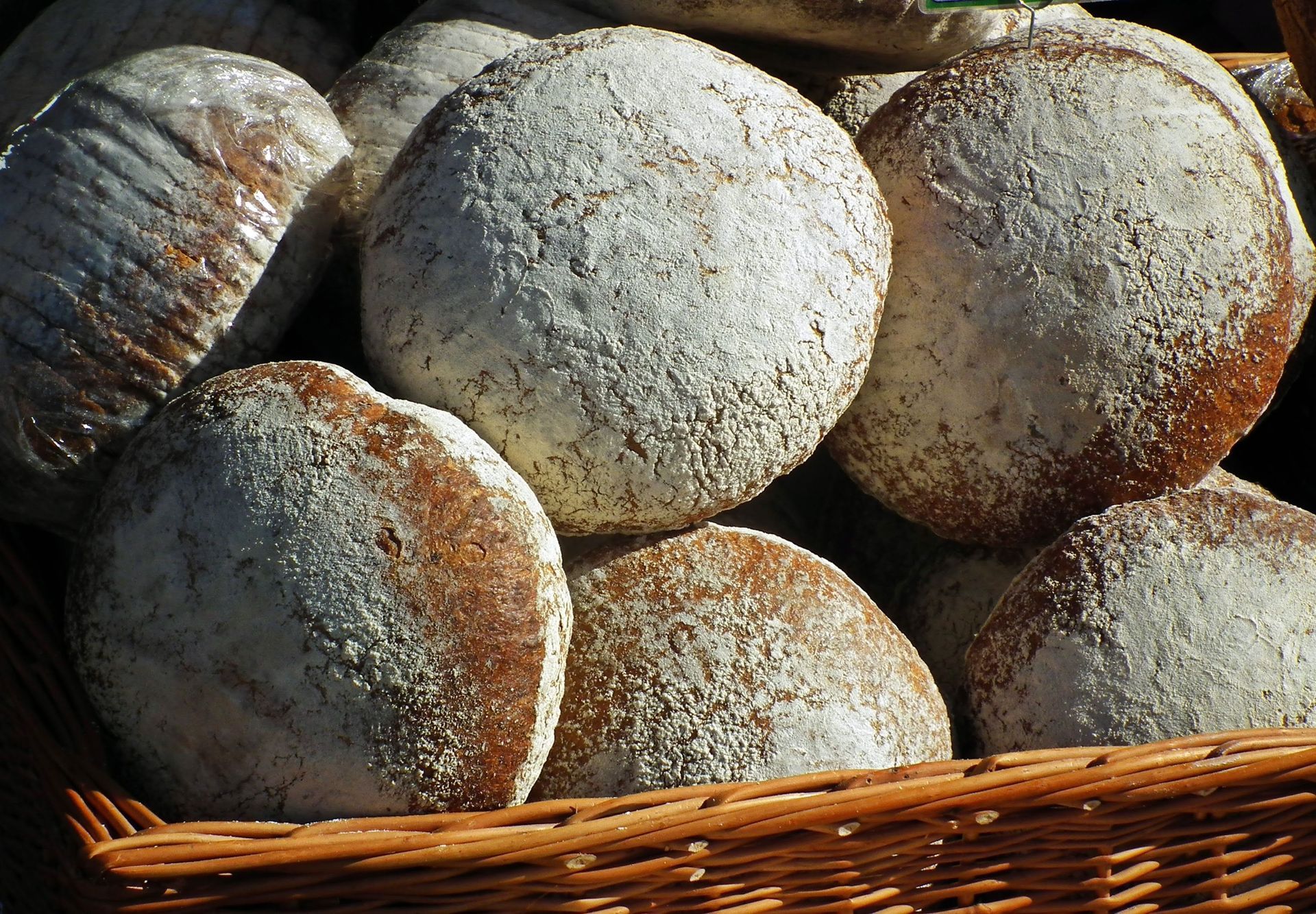
The Miracle of the Feeding of the Five Thousand is the only miracle which appears in all four Gospels. This is no trivial detail. The convergence on this event shows us how central it is to understanding who Jesus is, and what he came to do. But as with all of the Lord’s miracles and parables, it needs to be unlocked. Most sermons this weekend will focus on God’s generosity - indeed, his superabundant generosity, in meeting the needs of desperate people who would otherwise have suffered hunger. It’s not wrong to start there, but to conclude this is only a story about being kind and feeding the hungry is to miss a better point. You see, it’s really about the Word of God, and the ministry of the Apostles. How do I know? Well, two clues to start off with: (1.) the number of the items: five loaves and two fish, and (2.) this crucial piece of dialogue: “you give them to eat” The disciples realize that there is an impending problem: the crowd has followed Jesus into a desolate place, and unless they disperse into surrounding villages before nightfall they will go hungry. This is all entirely logical, but Jesus does not want them to do that, not because he has the power to provide food in this situation (of course he does; he is God and created everything out of nothing) but more because in performing the miracle he will teach the Apostles something about what they already have, something about what he can do, and something about what they themselves will be able to do through him. So typical of Jesus’s teaching: he uses one thing to explain another. So the disciples are aghast at the Lord’s command “you give them to eat” - their response is “we only have five loaves, and two fish”. Can you hear the tension? This is not a calm exchange; they are panicked. They are thinking in human terms - unless we make everybody happy, the mission is imperiled! Five loaves, and two fish. What do you think those things might represent? What do the Apostles already have to feed the people? The clue is in the loaves. What could specifically five loaves represent if not the Torah itself, or ‘Pentateuch’ in Greek, because it is divided into five books: Genesis, Exodus, Leviticus, Numbers, and Deuteronomy. To assign this meaning to the loaves is most appropriate, since the traditional author of the Torah is Moses, who feeds Israel with the bread of heaven in the desert. What then of the fish? The Hebrew Scriptures are traditionally divided into three parts: the Law, the Prophets, and the Writings (or Wisdom literature). Some modern biblical scholars have suggested that the combination of the five loaves and the two fish forms a kind of Hebraic code: five plus two makes the perfect number seven, and that the original hearers of Matthew would have understood this as the fullness of the Scriptures. On that reading, the two fish represent the Prophets and the Writings. Praying with this passage, I have found this insight quite compelling, because, unlike the Torah, both the Prophets and the Writings seem to come from somewhere more mysterious—like fish drawn out from the depths of the sea. They have flesh, but they also have bones. They nourish us richly, yet they are often harder to digest than the ‘bread’ of the Torah. This is what the disciples have to give them: the Bible. And what does the Lord instruct them to do with it? First - “bring them here to me” - then he looks up to heaven, blesses them, and breaks them, thereafter he does not distribute them to the people himself, but gives them to the disciples to distribute them to the people. Now the miracle begins to reveal what it is really about. The Scriptures must be brought to him, where he in his person blesses and breaks it open for the Apostles, who are then instructed to feed the people with it. Scripture is not self-interpreting; it is brought to Christ, who opens it, and then entrusts it to the Apostles to feed the Church. When they do, what happens then? Well here’s where it gets really interesting, first of all, there is an abundance. Everyone may eat whatever they can, but also there are fragments left over, which are gathered in (indeed, in John’s account, Christ commands the fragments be gathered in). The fragments. The klasmata in Greek. The Apostles are the ones who are able to break the Word into klasmata, and they are also the ones to gather in the fragments as well. St. Augustine in his commentary on this Miracle interprets the fragments not simply as the leftovers people did not want, but rather the pieces they could not eat - the bits that were too hard for them, and thus gathering the fragments is a symbol of the Church not throwing away the hard teachings, but keeping hold of them, to be distributed at another time. The breaking of the bread into fragments ought immediately to resonate with us as a Eucharistic community - and here the full meaning of the Miracle is revealed in what the Lord commands we do in memory of him until he comes again. What you receive from this Altar, is the Lord’s Body and Blood, and since the Lord is the Word who is both with God and is God, in a very real sense, you feed on the Word of God every time you receive Holy Communion. For my part, I am entrusted with the fragments. My role in leading the assembly is both to break and to gather. Note that I am charged to break, but not to shatter. The breaking of the bread is not a destructive action, but a constitutive one. In breaking the bread, we are made one in it, because the broken Christ is not a diminished Christ. He is not made weaker by being broken, instead we are made stronger. But back to the fragments. From this Miracle, we could say that the clergy are ‘men of the fragments’ - and this is rather satisfyingly even more true than first appears. You see, it’s in our very title. You may call me a ‘cleric,’ of which clergy is the collective noun. But the word, ‘cleric’ is not of English origin, nor is it Latin. It is in fact Greek - deriving from the word ‘klerikos’ This word carries the idea of a portion broken off and allotted - the original way of casting lots. A cleric is one to whom a portion has been given, and who is then charged to break and distribute further fragments. A cleric is thus the man who breaks, who apportions, and who gathers, because the example was given to him from the Apostles, to whom the portion was given by Christ himself. I stand here as a man of the fragments. Not because I possess abundance, but because I have been given a portion and charged to break it for you without shattering it. The Church needs men willing to keep the hard pieces and to keep feeding the people with them until Christ comes. That is the work of a cleric. That is the lot that has been apportioned to me, and as the Psalmist said: it is truly a ‘goodly heritage’. This, then, is the mystery into which you enter into every Sunday at Mass. Here Christ still takes what he has entrusted to his Church: he opens the Scriptures; he feeds his people; and he gathers up every last fragment. In so doing we see that the Word is not simply a text, but a person: the Word made Flesh, broken yet undivided upon this altar. Come, then, and receive the Bread of Heaven that has been broken for you, trusting that nothing Christ breaks is ever shattered, only multiplied, so that you may have life, and have it in abundance.

Are you afraid of flying? I was. It was totally debilitating. Every time I wanted to travel somewhere I was a nervous wreck for days, even weeks, before. Sleepless nights, chills - the lot. It was awful, and I’m very sympathetic to anyone who suffers with it. Now I’m completely calm, even if there’s awful turbulence. I still don’t like flying at night much though - and the reason for that will become clear. The cure for my fear of flying came when I traveled on a short flight with a friend who used to serve in the Royal Air Force. He loved everything about the whole experience - and the bumpier the better. His advice was simple: “look for the horizon”. What feels like dropping a thousand feet, in reality is nothing like that. And the shakes and bumps - that’s just the fuselage flexing, as it’s designed to do. If it didn’t flex and bend, it would shatter. In time, all the things that used to terrify me so much became background noise most of the time, and - if I think of them - I’m thankful for them. The disciples, of course, were not sitting comfortably inside an airplane. They were in a little boat, at night, with the wind against them. But they had the same problem I had: they could no longer tell the difference between what was frightening and what was actually dangerous. If you look carefully at the text, they are not afraid of the waves pounding the boat, they are afraid of two things: the wind — and Christ himself. Fear can make us absolutely certain we have understood a situation correctly, when in fact we have understood it completely backwards. Fear does not merely make unpleasant things frightening. Eventually fear can make even Christ frightening - and there’s the lesson this Gospel wishes to impart. The best interpretation of this miracle is very ancient. It’s a sermon given by St. Augustine and dates to the early 5th century in North Africa. It was preached in the context of the Liturgy, because it refers directly to this Gospel having been read, and in it, Augustine uses every part of the text to paint a vivid allegory of the Church battling with the prevailing winds of society. This sermon underscores the idea of the Church being the ‘Barque of Peter’ - reminding ourselves that the one we most often associate with a shepherd’s crook is really a fisherman, with his hand on the tiller of the Church, plotting the best course through the waves of time. But there’s one more detail that’s easy to miss. Do you see how the Bible tells us the Lord walks on water in the fourth watch of the night? What does that mean? Do you know? Well, the night is divided into four watches, and so we’re talking about the time between 3 AM and 6 AM, when the night is at its darkest. So by analogy the Church is battling all through the night, and Christ seems to be far away, even having abandoned us, but it is at the last moment he comes to us, showing that the things which frighten us are no obstacle to him, at all. What does this even mean? Well, notice another detail: the Lord made the disciples get in the boat without him. He commands it. He wants us to undertake this journey. As Augustine said ‘nemo quippe in hoc saeculo non peregrinus est’ - which means ‘no one in this world is not a pilgrim’. The journey is part of the plan. It involves engaging with the turbulence of the wind and waves, but in a vessel designed to withstand them. No accident, then, as Augustine also points out, that our feet stand on wood when we traverse the waves - for the boat is the Cross of Calvary. This is the vessel that permits us, with Peter at the helm, to push on towards dawn. So this Miracle is not simply a remarkable story of what happened to Jesus’s friends on Lake Galilee one day. It is a mirror, for us, of our lives in the Church. We are in the boat with Peter, it is dark and Christ seems far away. We cannot see the horizon, and all we know is that the wind is against us. But in the story, we may also cling to hope, because Christ is coming towards us, unperturbed by the roaring of the waves or the raging of the sea. By Faith, we can even walk out to meet him. But the moment we fail to fix our eyes on him, and we imagine the strength of the wind, we begin to sink. Why did you doubt? He asks, as he gets into our boat. Faith does not mean pretending there is no turbulence; it means refusing to confuse turbulence with catastrophe. The Church being tossed about by powerful unseen forces from outside of her is not a sign of imminent danger. Why not? Because we have Christ. Not Christ watching from the shore. Not Christ waiting for us when eventually we reach the other side. Instead Christ coming towards us in the darkness, in the middle of the night, walking upon the very thing that frightens us the most. Perhaps then, the next time the plane shakes, you might still grip the armrest. Faith doesn't necessarily stop you being frightened. Peter was frightened, too. But maybe you should remember this: I am experiencing turbulence; but that does not mean that I am experiencing catastrophe. That is also something worth remembering when the turbulence is not in an airplane, but in your marriage, your family, your work, your finances, your health, or even your Faith life. The wind is real. The waves are real. But they are no match for the Lord. When we find ourselves in the boat, in the dark, my friend’s advice is as good for you as it is for me: look for the horizon! The Christian is not someone who experiences less turbulence. The Christian is someone who has learned where to look for reliable data. The storm may not change, but your understanding of the storm can change. When you cannot see where the sea ends and the sky begins, when every familiar landmark has disappeared, it is precisely there you discover your horizon is none other than Christ himself.

I beseech you brethren, by the mercies of God, to present your bodies, a living sacrifice, holy, unto God, well-pleasing; which is your reasonable worship. Romans 12:1 is one of the most important verses of the entire Bible. From it, Holy Church receives her mandate for active participation in the Sacred Liturgy, encapsulated by the mysterious phrase ‘a living sacrifice’. Combined with 1 Peter 2:5, we understand from the twin Apostles of Rome that the ‘living stones’ are built into a ‘spiritual house’ in order that we might become holy: a living sacrifice acceptable unto God. In a few moments I will address you from the Altar before I make Christ’s sacrifice present before you. I will beseech you in a similar way to St. Paul in his Letter to the Romans. Indeed, the words of my exhortation derive unhesitatingly from his. I will turn to you and say: “Pray, brethren that my sacrifice and yours be acceptable to God the almighty Father ” My sacrifice and yours. What an audacious thing for the Church to say. The sacrifice upon the altar is Christ’s sacrifice: the one perfect sacrifice, accepted once and for all upon the Hill of Calvary. It cannot be repeated, improved or supplemented. And yet the Church dares to call it my sacrifice and yours, because Christ does not desire for us to observe as as spectators at the foot of his Cross. Instead, like the Blessed Virgin he desires for us to be drawn actively and completely into his offering. To understand this, we have to re-examine what we mean by sacrifice. There’s a musical setting of Romans 12. It comes at the end of a choir anthem called Greater Love Hath No Man by the Edwardian composer, John Ireland. He sets the words ‘a living sacrifice’ really rather wonderfully - he allows the music to arpeggiate into the word ‘holy’ in a way that is most faithful to St. Paul’s emphasis. The living sacrifice is the mystery which interrupts like the dawn. We choirboys were not always that angelic. Musical scores are littered with, let’s say, ‘marginalia’ if the words or text are particularly evocative. In Exeter Cathedral, the phrase ‘living sacrifice’ in Ireland’s score has been ‘illustrated’ quite imaginatively. It must have coincided with the release of the movie The Wicker Man because the boys decided St. Paul had in mind a towering inferno with a hapless victim caught inside. He didn’t. But their conclusion - the surface reading of ‘living sacrifice’ uncovers a deeper truth. It’s a nonsense. How can you possibly have a living sacrifice? It doesn’t make sense. If you sacrifice something (and the word means to make holy) you have to give it up, don’t you? The Temple in Jerusalem was built all around the idea of animal sacrifice - thousands upon thousands of animals slaughtered and burnt. Hardly a sacrifice if it doesn’t involve the permanent destruction of the offering. But St. Paul in writing to the Romans has a totally new perspective on sacrifice. A perspective that is the innovation of Christianity - a truly sacrificial system based upon the perfection of the God-man, Jesus Christ, the Word made Flesh. Romans knew what sacrifice meant - but the Apostle says to them, Christ’s is the only sacrifice acceptable to the Father, only he is good enough to atone for the sin of all humanity, because he is perfect. But what Christ offers in the Liturgy is the pathway for you and me to participate in that one, saving act. The night before he died, he instituted the Eucharist, and commanded us to do this in remembrance of him. This remembrance is not simply a calling to mind of a historical event, but a making present of a singular pivot in time, in order that we might share in it. Being liturgical is therefore what gives us access to the well-pleasing sacrifice of Christ. Being liturgical is not an optional extra, a hobby, or a pageant. Being liturgical is the only way we can offer the sacrifice of praise that the Father accepts because of the goodness of the Son. Paul tells the Romans that their way of life is what unites them to Christ’s sacrifice. If you imitate Christ in his goodness, you will endure suffering in this world. If you are of the world, the world will leave you alone, if you are not of the world, the world will hate you, persecute you, and accuse you of all kinds of falsehoods on account of his Name. Brothers and sisters, this suffering is the content of your offertory. When I turn to you and say “Pray brethren that my sacrifice and yours…” I am not talking about the collection. I am talking about your life - your trials, frustrations, forbearances, failures, insults, oppressions, hardships and illnesses. The world has no answer to this suffering. None at all. It’s purely meaningless, and to be avoided at all costs. But you and I are not of the world. Our sufferings, whatever shape or size they may be, are not meaningless. On the contrary, they are the content of your living sacrifice, holy and well-pleasing to God. Do you see now how the Sacred Liturgy is not governed by our preferences? ‘I like this’, ‘I don’t like that’: all irrelevant. We don’t worship in this way because it expresses our communal identity, or because we like the sound of this kind of music. We worship in this way because the Church discerned over centuries this way best expresses the reality of the living sacrifice. The moment we start to express personal desires is the moment we demonstrate we have not yet understood what the Sacred Liturgy is all about, because our taste has nothing to do with whether the worship is true, or reasonable. That phrase, translated as ‘reasonable worship’ at the end of this passage sums up our activity here this morning. Presenting our bodies to be accepted by the Father through the perfect sacrifice of the Son is indeed rational, it makes sense! Logikē latreía is how the Apostle describes it, where the adjective derives from ‘logos’ which means word and also ‘reason’. Christ is the Word of God, and thus he is in himself God’s reason, but at the same time God’s communication of himself to us. So St. Paul describing our worship as logikós is exceptionally deep. Yes, the Liturgy is reasonable on an everyday understanding, but it is also Word-like worship, logos-like worship: Christlike worship. Presenting our bodies as the holy living sacrifice at Mass is the most Christlike thing we ever do. This is what active participation in the Sacred Liturgy really means. It does not mean that everyone must perform some activity. Active participation means that everyone offers his body as part of the one living sacrifice, which is holy to God. So when I turn to you and say, “Pray, brethren, that my sacrifice and yours…” do not let the words wash over you as they may have done week by week. Place upon the altar everything you have carried into this Church. Let Christ take what is yours into what is his: many bodies made one Body; many sufferings made one Sacrifice; our whole lives made holy, well-pleasing unto God, which is truly our reasonable worship.

Lord, how often does my brother sin against me, and I will forgive him? Up to seven times? Jesus says to him: I do not say to you up to seven times, but up to seventy times seven! Many of you here are numbers guys, or numbers gals. I’m not a numbers guy, I’m a bluesky-20,000 feet kind of guy - but the Apostle Peter is clearly a numbers guy. Put aside the translation discrepancy - the New American Bible says we must forgive seventy-seven times, whereas I think the Greek says seventy times seven, i.e. four hundred ninety times - Peter wants to know - what is God asking of me? How do I know I’m right with God? And to answer that question, like a good and faithful son of the Covenant he looks to the Law. If I do what the Law requires, I’m good with God? Yes. But you still cannot share God’s life. Sharing God’s life means not just that you receive God’s forgiveness in the world, but that you become God’s forgiveness in the world. Not because forgiveness is an especially good virtue. It’s more basic than that. It’s because forgiveness is what love looks like when it encounters sin. This means, if I cannot say I am reconciled to God if I do not forgive my brother, my neighbor, or even my enemy, from the heart. The New Covenant, in Christ’s blood, does not permit a chamber of the heart to be set aside for vengeance and hate. Forgiveness is an act of the will, and since in Biblical anatomy the heart is the seat of the will, my heart must be pure if I am to see God. Let’s dive deeper into the numbers a moment. Peter and the Lord are actually having a ‘typological’ conversation with these numbers. There is a code language going on here - because each number calls to mind a specific instance of forgiveness and reconciliation in the Scriptures. Peter is actually being rather generous according to the Law. Leviticus 19:17-18 gives us the mitzvah about forgiveness and bearing a grudge, but doesn’t give a number. The rabbis interpreted this as requiring forgiveness three times, and thereafter the matter would be considered closed. We can safely assume that observant Jews will have known and understood what Leviticus 19 required. Peter, in proposing up to seven times is being more than twice as generous. He proposes more than double what the Law requires, and in so doing calls to mind the mark of Cain. You remember that God puts a mark on Cain that anyone who harms him will receive sevenfold vengeance. How do I know this is the reference? Because of the Lord’s answer. The Lord choosing ‘seventy times seven’ in response to Peter recalls the deepening of blood vengeance proposed by Cain’s descendant Lamech in Genesis 4:24 “If Cain shall be avenged seven times, then Lamech seventy and sevenfold.” Man had entrenched violence and hate, deepening it an infinite number of times; God proposes a reversal of this abyss, requiring infinite forgiveness as a condition of reconciliation with God. In so doing, the Lord also touches upon the messianic prophecy of Daniel: Seventy weeks are decreed about your people and your holy city, to finish the transgression, to put an end to sin, and to atone for iniquity, to bring in everlasting righteousness, to seal both vision and prophet, and to anoint a most holy place Daniel 9:24 The ‘seventy weeks’ is a number play on seventy ‘sevens’ after which the sovereignty of the one Daniel describes as ‘like a Son of Man’ begins: the true, messianic jubilee - that is, the ‘year of the Lord’s favor’ where everything is reset. So in all this, what looks like hyperbole is in fact deeply, deeply significant numerology. The dialogue between Peter and the Lord establishes: The insufficiency of the Law The pitiful condition of man locked in vengeance The infinite love of God looks like infinite forgiveness Such forgiveness is the meaning of the Messianic jubilee. We misunderstand everything if we forget that forgiveness is essential to Christianity. If we do not forgive, we have not yet been reconciled to God. If we have received mercy - and we have - every single one of us is a grave sinner in need of God’s mercy, no exceptions - then we must be merciful in response to what we have received. No ifs, no buts. To illustrate the point, Jesus tells a story for the numbers guys like Peter. One servant owes ten thousand talents: sixty million days’ wages—something like two hundred thousand years of work. It is not a large debt. It is an impossible debt. No repayment plan could touch it. The master simply forgives it. Then that servant finds a man who owes him one hundred days’ wages. That is not nothing. Jesus does not pretend that the sins committed against us are nothing. Some of them are grievous. Some leave wounds that last a lifetime. But the proportion is six hundred thousand to one. That is the point. Christianity does not ask us to say that evil does not matter. It asks us to see the evil done to us within the immeasurable mercy God has shown us. Forgiveness does not mean pretending that nothing happened. It does not necessarily restore trust, remove consequences or return an unsafe person to intimacy. Forgiveness means that I renounce vengeance; I refuse to make another person’s destruction my good; I surrender the debt to God. Cain demanded vengeance sevenfold. Lamech demanded it seventy-sevenfold. Humanity multiplied vengeance until the earth was soaked in blood. Christ now reverses the multiplication: not vengeance without limit, but mercy without limit. Peter asks, “How much forgiveness is enough?” And Jesus answers: “As much as you have received.” For forgiveness is what divine love looks like when it encounters our sin. And if that love has truly entered us, then forgiveness must become what our love looks like when it encounters the sins of others. And before we excuse ourselves, the unforgiving servant can hide in us in several ways. “I have nothing for God to forgive”—that is blindness. “Nothing will happen if I refuse to forgive”—that is complacency. “I simply do not want to forgive”—that is the will choosing vengeance. And “I have said that I forgive, but I intend to keep the debt alive forever”—that is forgiveness only with the lips, not from the heart. Christ does not command us to feel differently on demand. He commands an act of the will: that we surrender the debt, renounce vengeance and entrust justice to God. The wound may remain; trust may have to be rebuilt; reconciliation may require repentance. But hatred may not be given a permanent room in the Christian heart.

To understand this parable, the most important line is this: Is it not lawful for me to do what I will with what is mine? Because, what is required of us in hearing the message is a firm recognition of the sovereignty of God. God does not require your permission to be generous. Since he is goodness itself, if his goodness appears unjust to you, it is your vision—not his justice—that needs correction. As the Psalmist says: Our God is in heaven; he does whatever he wills. The Lord’s manner of telling this story is a clever literary device, because almost everyone who hears it will instinctively conclude that it is unfair to the workers who arrived early. It deliberately provokes that reaction, because it requires a change of heart if we are to accept its teaching. In other words, you cannot hear it, and go on thinking the same as you did before. Deeply ingrained in our collective conscience is the idea that equity requires equal pay for equal work. Ordinarily, that is quite right. But such a judgment belongs to a world measured by hours, days and years: a world with a yesterday and a tomorrow. But this parable concerns eternal life, in which there is no yesterday, and no tomorrow; only now. You cannot possess more eternal life than anybody else, any more than you can be eternal for longer than somebody else. It is a one-coin reward: the eternal denarius, so to speak. Whether you accept God’s offer early or late, what he gives you is eternal life. That is the generosity of God. But the parable also warns us about the corrosive power of envy, resentment and bitterness. Is your eye evil because I am good? Our translation renders it: Are you envious because I am generous? The literal expression of the Greek is stronger, because it evokes the temptation to look over the fence at our neighbor, to see if what they have is better than what we have. But if our response to divine generosity is envy, then this calcifies into resentment, for as long as we remain convinced that we are right and God is wrong. Hold on to that judgment, and you will never be at home in God’s household. But what of our sense of justice? Does not justice require some proportionality between our work and our reward? Yes, and here we may perceive another dimension of the parable. Eternal life is offered by God to all, but that’s not the end of the story. Although it is given whole and entire to every soul that dies in God’s friendship, not every soul possesses the same capacity for the glory of God. Put simply, in heaven each of us participates in God’s life according to our capacity to receive it. Let me help you with an analogy. Imagine every soul in heaven as a vessel filled completely with the life of God. No vessel is half-empty. Each one is filled to the brim, and overflowing. Yet the vessels are not all the same size. Each soul is perfectly happy according to its capacity, but those capacities differ; and therefore the blessed are happy in heaven in differing degrees. It is our cooperation with grace whilst we live on earth that enlarges the soul’s capacity for God in heaven. This is the labor in the vineyard. The great saints are not given a different heaven; they receive more deeply the one, undivided life of God. Our wrestling with God on earth is therefore not work done in expectation of payment. It is the work of grace forming within us a greater capacity to receive the divine life for all eternity. God doesn’t offer a goal-oriented system: the struggle is the point. And this permits me to make an extraordinary claim: God loves some people more than others. This does not mean that God experiences stronger and weaker emotions towards any of us, nor that he is capricious, whimsical or arbitrary. His act of love is one, eternal and unchanging. But to love is to will the good of another; and, as Aquinas teaches, God loves someone more when he wills a greater good for that person. Since he gives differing measures of grace and glory, his love has unequal effects. You and I love people because of the goodness we find in them. God’s love is different. He does not discover goodness in us and then decide to love it; by loving us, he creates the goodness that he loves. A soul does not receive greater glory because God discovers it to be more lovable. It is more lovable because God has produced greater goodness in it, and the soul has freely cooperated with his grace. God doesn’t offer a goal-oriented system: the struggle is the point. A longer span in the vineyard gives us more opportunities to make that response—but there is no mechanical correlation between years of service and heavenly glory. A person may spend his whole life in the vineyard, while resisting grace at every turn. Another may arrive at the eleventh hour and respond with heroic love. The decisive question is not simply how long you have been present, but what you have permitted grace to accomplish in you. There is no advantage in a deathbed conversion. To enter the vineyard early is already a privilege. It means more years spent in service of the living God, and more opportunities for grace to enlarge the soul. This helps us understand why heaven is a hierarchy. The saints and angels are not equal in glory, because they do not all participate in God’s goodness to the same degree. Consider the Blessed Virgin. No creature has been loved by God with a greater love; no creature has received a greater fullness of grace; and no one has cooperated with grace as perfectly as she did. She therefore possesses the greatest capacity to receive the life of God. This is what makes her the Queen of Heaven. Would it be fitting for any one of us to claim equality of glory with Our Lady? Our instincts should answer, by no means. Yet the least soul in heaven and Our Lady herself both possess eternal life equally. Each is filled completely, but each according to a different capacity. Each is perfectly happy, but Our Lady enjoys a greater degree of beatitude, because she is capable of receiving more of God. God’s ways are not our ways. We look at the vineyard and ask, “How much will I get?” God asks, “How much of my life are you becoming capable of receiving?” That is the real test. Do we resent grace when it overturns our expectations? When God welcomes the latecomer, forgives the sinner or changes arrangements to which we have grown attached? Or do we rejoice in what grace can accomplish, both in others and in us? If we desire what grace can make of us, then we might even sing a song as we toil beneath the heat of the midday sun. Our stability does not depend upon preserving the routines of this passing world. It depends upon Christ, who is constantly urging us more deeply into his life. The labor itself is already a gift. To spend one’s life in the vineyard is not to be cheated when another arrives at the eleventh hour. It is to have allowed the service of God to enlarge the soul until, in eternity, it can receive as much of him as it is able to bear.

The three ‘kingdom’ statements in the Gospel this week are vivid descriptions that really spark the imagination. The Lord tells us the kingdom is like buried treasure, the pearl of great price, or a net full of fish of every kid. But have you ever thought of them as applying to the Church specifically? It’s sometimes important to decouple the idea of the institutional Church (be it Parish, or Diocese) and all the paperwork and (sometimes very necessary) bureaucracy that goes with that, from the spiritual concept of a community of believers. Now, the Kingdom and the Church are not precisely the same thing, but the Church is the visible evidence of the beginning of Christ’s reign as King - and, as Vatican II taught, the universal sacrament of salvation. It looks like one thing (a ragtag mixture of saints and sinners, who at times barely seem to get along) but is in fact another (Christ’s own body…and bride, perfect and unspotted). In all its incongruity, the Church is the vehicle of the Kingdom - it’s how God’s Kingdom comes about - not by any other means. So let’s look at each image - first the buried treasure. Well, the idea that being part of God’s Kingdom is valuable is obvious enough - of course it’s treasure - but buried…now this is intriguing. It tells us that this valuable thing is not immediately obvious. It needs to be sought out, and discovered, and whosoever uncovers this treasure possesses everything, because he possesses Christ. Secondly, the pearl of great price - again, the idea that it is valuable is obvious, but here it’s also beautiful, and rare. That the Church must be beautiful is not accidental - beauty is not a ‘nice thing to have’ - it’s essential. Of the essence of the Church. For this reason ugly churches, and ugly liturgies are not faithful to the Kingdom. But the image is even deeper. A pearl’s beauty is the price of irritation - the grit in the oyster shell that turns into a perfect, iridescent sphere. The Church’s beauty comes at a great cost, and is born out of suffering. Finally, the net. We describe ourselves as Catholic, and for many of us being Catholic is a defining characteristic of our family lives. How many of us say “I’m Irish/Italian/Polish/Croatian/Latino/Filipino…of course I’m Catholic” - but in saying that we must always be careful to understand that our idenitity as Catholics comes from the rich diversity of peoples who all belong to the Church, each with their own traditions and customs. To be proud to be Catholic is to defend unity in diversity, and to appreciate the customs and heritage of others. Or, to put it another way, because we are Catholic, someone else’s customs become mine to enjoy. The Church is not Catholic because she contains many cultures. She is Catholic because Christ gathers every nation into one Body. Therein lies the beauty of the Kingdom: it is made stronger by recognizing the numerous ways God blesses his people; and therein also lies the beauty of the Church: where the Kingdom is already breaking into the world: many peoples, many customs, but one Lord, one Faith, one Baptism. Deo gratias.
I’m sure you’ve heard a number of times: the Bible is a library, not a book. But even within books of the library we can further discern direct speech of the Lord, and its surrounding narrative or commentary. The three Synoptic Gospels (Matthew, Mark, and Luke) so-called because they represent a synopsis, or compilation, of the Lord’s teaching, are clearly designed to act as a resource, or aide-memoire, for the authentic transmission of the Faith. Take the Parables, for example. Last week, we encountered the Parable of the Sower, with its private explanation to the Apostles following immediately afterwards. This week we have the Parable of the Wheat and the Weeds, with its accompanying private explanation. This is very unusual. In fact, with the exception of fragments and comments from the Lord, these are the only two examples of Jesus authoritatively explaining his parables. That is not to say the other 37, or so, parables of Jesus have no authoritative explanation, and it’s up to you to interpret it as you like. Instead, it’s important to realize that we have a snapshot, with these two parables, of how Jesus taught the people, and how he passed on the key to his teaching to the Apostles. We can be certain, because Scripture tells us, that not everything Jesus said was recorded - and it’s a fair deduction that this pattern of public teaching, and private explanation, was typical of how the Lord delivered the Word. Indeed, Scripture also says: he said nothing to [the crowds] without a parable. From Matthew 13, Jesus explains why he teaches in parables: (1.) because in his own words: it has been given [to the Apostles] to know the secrets of the kingdom of heaven, but to [the crowds] it has not been given, and (2.) this method fulfills what was revealed by prophecy. In other words, the presence of the Apostles to receive the Word, both publicly and privately, is indispensable for us to understand accurately what the Lord meant. The Lord did not simply leave behind inspired words. He also established inspired hearers—those to whom he entrusted the mysteries of the Kingdom and to whom he explained what the crowds could not yet understand. Scripture itself therefore points beyond private reading to the apostolic ministry of interpretation. This has enormous implications. One of the key demands of reformers from the 15th Century onwards was the proclamation of Scripture in the vernacular, in a language people could understand. You might even think to yourselves - how was it ever sensible to proclaim the Scriptures publicly in a language people didn’t understand? That’s a very logical observation! It has two main answers: The first is the Liturgy was never seen as the primary place for catechesis. From the earliest archaeological evidence we possess, Christian communities were already adapting their meeting places for distinct ecclesial purposes, rather than treating worship and Christian formation as one and the same activity. The liturgy was never expected to carry the whole burden of catechesis. But the second is a consequence of Matthew 13, and Christ’s own pedagogical method. If (as Scripture reveals) the Lord teaches in parables, which require private interpretation to those to whom the secrets of the kingdom of heaven have been entrusted, then to proclaim the written Word to a public assembly without immediate commentary would be to give only half the story - and delivered parabolically too! The danger would be that the hearers would all come to their own conclusions as to what the Scriptures meant - and such an approach would elevate private judgment over what holds us in communion. Now, before you get your pens out to write the Bishop or the Pope, I’m not advocating for going back to routinely proclaiming the Scriptures in Hebrew, Greek or, dare I say it, Latin. You will not find a priest who is more enthusiastic about Biblical literacy amongst the Lay Faithful than me. I think it’s essential you know your Bible, and I intend to offer more and more ways for you to do just that in our Parish. You have told me you want more adult formation, and more adult formation you shall have! But that’s the point - at the very least, public proclamation of the Scripture in a language people understand requires careful preaching on the Scriptures themselves - not simply comforting anecdotes, or pious platitudes. Preachers must engage the texts deeply - and to do this, they themselves need to be experts in the Bible too. But in addition to good preaching, we need excellent catechesis too - so that hearing the Word becomes a lifelong journey of discovery for every Catholic Christian. Perhaps an argument could be made that in being cautious about private interpretation, the pendulum swung too far, and the treasures of the Scriptures were not as freely available. But I think that does a disservice to the catechetical methods of the medieval and early modern periods. If you went back to 14th century England and met a typical laborer, he probably could not read or write, but he did know his prayers, and he did know his Bible stories. How? Because of oral catechesis that has left little trace in archaeology or text-based history. So if private interpretation is out, let me offer you a different way of inhabiting the Scriptures - one that comes from St. Ignatius of Loyola. In the Spiritual Exercises, Ignatius encourages his followers not simply to observe the scenes passively, but to inhabit them actively, or, in his words ver con la vista de la imaginación el lugar corpóreo ‘to see with the sight of the imagination the physical place’. To do that, we need to know the background - for example, today’s Gospel is not delivered in a lecture hall, or even a synagogue, but outside. The narrative tells us the Lord comes out of a house (probably in Capernaum) and begins to teach by the lakeshore of Galilee. On account of the crowd, he gets into a boat, but then returns to the house in order to give the private explanation to the Apostles. Looking out at the crowd, don’t you think he noticed that some were with him, and some were against him? When you know the physical surroundings, the image of the wheat growing amongst the weeds makes perfect sense - Jesus is looking at them! Now let Ignatius take you one step further. Don't remain sitting in the pew as a spectator at the theater. Place yourself by the lakeside. Hear the waves against the boat. Feel the heat of the Galilean sun. Look at the faces around you. And then ask yourself a far more important question than, "What does this parable mean?" Ask instead, "Where am I in this crowd?" Am I listening in such a way that I am content merely to hear the story, or do I want to follow Christ into the house, with the Apostles, to receive its fuller meaning? That is how Catholics read the Scriptures—not as detached critics, nor as isolated interpreters, but as disciples, who hear the Word proclaimed liturgically, allow it to engage both mind and imagination, and then ask the Spirit to lead ever more deeply into the mysteries of the Kingdom.

I'm trying the 'no-dig' method in the garden right now. The theory is simple: don't keep disturbing the soil. Feed it from above, let the worms and microbial life do their work, and resulting healthy soil will produce vigorous plants. It remains to be seen whether it’s a sufficiently Biblical method, but today's Gospel reminds us that Our Lord was certainly interested in the conditions of the soil. First we meet the path - here the soil has been trampled by human or animal traffic. I don’t think we’re talking Connecticut Bluestone here. Instead, the crumbly earth has been compacted so that there’s no room for the seed to germinate, and the soil has no capacity for light, air, or moisture. It resists new life by its unyielding texture, leaving the seeds vulnerable to being picked off by the birds. Secondly we meet the rocky ground - here there is open soil, and capacity for some light and air, but there are two major problems: first, the rocks, do not permit space for growth in exactly the same way as the compacted path; but secondly their presence means the soil has reduced capacity for water, meaning a seed that germinates quickly withers, because it cannot be sustained. Thirdly the thorny ground. Let’s look at this more deeply. Thorns are not a different kind of thing from the plant that the seed will produce. Thorns are plants too, and they come from seeds, just like all vegetal life. But they jostle for space and resources with the seed the Sower wishes to have grow in the soil, and because of their inherent qualities of vigor and hardiness, they choke the delicate seed and cause it to fail. In Greenwich the thorns are rarely obvious sins. More often they are perfectly respectable things: careers, investments, children's schedules, college admissions, athletics, houses, vacations. None of these is evil. Indeed, many are good. But if they occupy the best soil of the heart, they become thorns. Finally, the rich soil. The jury’s out on whether this is a ‘no dig’ lasagna sheet of cardboard and compost - but what we do know is that this has optimal conditions for the seed once sown to germinate; there are no inherent obstacles in the structure of the soil, like the path or the rocky ground, and there are no competing plants as with the thorns. But note two things that are very important: First of all, from the previous examples we can be sure that the seed of the Word takes longer to germinate and grow than the seeds of worldly anxiety or lure of riches. How often this is the case with prize seeds - gardeners know very well things of little value grow quickly and easily, but things of great value take time to establish themselves, and put down strong roots before top growth. Secondly, note the the aim of this growth is to produce fruit. Stems, leaves and flowers are secondary to the aim of the sower, which is to reap a harvest. Therefore, the Word sown in us is supposed to bear fruit, and as we know, fruit contains seed that is of the same species as the plant which bore it. So, Our Lord tells us about seed and soil, but every gardener knows there are other necessary conditions for growth. We know from biology that even a good seed sown in soil will not grow without adequate moisture, air, and light. Whilst they are not part of the Parable itself, what might these represent? Well, I think the moisture is straightforward. Water is grace, which appropriately enough for our image comes from the heavens and is poured out on the earth without exception: the path, the rocky soil, the thorns and the rich ground all receive this outpouring of God’s goodness. The difference between the soils is their capacity to receive it - what makes a path hard is its resistance to moisture, what makes a soil rocky is its lack of capacity to retain it, what makes the thorns thrive is their ability to divert God’s goodness for their own ends, whereas what allows us to describe soil as ‘rich’ is in direct proportion to its ability to manage the reception of moisture. So too with grace. Over time the soil of our hearts can become compacted and resistant to God’s grace, so that it flows over and around us, without penetrating the soul, or perhaps part of our soul is rocky soil, with boulders of resistance and dusty silt that has no capacity to retain grace. The seed of the Word is perfectly sufficient in itself, but the Sower is not content just to produce seeds, he wants fruit. Air represents something intrinsic to the structure of the soil that permits receptiveness to grace; something within us, and shared naturally by all of us, if our soil is in good condition, but also something that can be damaged, as in the examples of the path or the stony ground. I think a good candidate for this must be reason. To respond to grace requires us to think, logically, rather than simply dart about, reacting to our emotions. When the Sower sows the seed of the Word in our heart, if we act irrationally, it would have no space to put out its roots and tendrils into our nature. Finally, what about the light? Anyone who has started their dahlias in the basement will know a seed can germinate in the darkness, but quickly degenerates without light. What could the light be? Well, think of the structure of any plant. They are, if you like, natural solar panels, oriented to the light. They produce energy from the light itself, and the leaves are designed to receive it and the plants flourish because of it. For the soul, the light must be God’s glory: his very presence is magnificent, and the seed of the Word exists to reflect his glory. In all eternity we need not lamplight, nor sunlight, because God himself shines on us. If we allow the seed of the Word to grow in our soul, we become a fruitful plant, whose very existence tells of the glory of God. I've no idea whether the 'no-dig' gardeners are right. I’ll let you know another time. But I do know this: the Sower is still sowing. The question today is whether our hearts are becoming the kind of soil that will bear fruit. And perhaps that's the question each of us should take away today: what, in my own life, is the fruit the Sower has been trying to grow?
I first set foot on American soil in 1997. I was a teenager, visiting family friends in an affluent town outside of Boston. It was around this time of year, because I remember the incredible 4th of July Fireworks that seemed to go on for ever, but an abiding memory was an enormous American Flag hanging from a colossal arch by the waterfront in the city. It turns out Old Glory was everywhere - from bunting in the suburbs to sentinels on the hilltops. America was confident, inquisitive, and positive. I’m glad I witnessed this America, because when I next visited the dust still clung to the nostrils in lower Manhattan. It was just a few months after 911, and New Yorkers were trying to rebuild lives that had been torn apart. Even here in Connecticut, the parking lots of the Metro North bore witness to the biggest challenge to our Union since Pearl Harbor. Everyone was affected. This America was different: still confident, but wounded, and more cynical than it was before. In the quarter-century following, the world has changed yet again - and we are on the cusp of a new Technological Revolution that will inevitably alter how we live, work, and play. Change is never something we can insulate ourselves from - it happens, whether we like it, or not. But what we can reflect upon this weekend is whether we have as the Psalms say a ‘goodly heritage’ allotted to us. I believe we have. And this semiquincentennial anniversary is a time to look both backwards to history, and forward to the future. As the Lord himself teaches us - an inheritance is morally charged. Think of the Parable of the Talents, or even the Parable of the Unjust Steward. Doing nothing with our inheritance is, in fact, to squander it: the moral equivalent of cash in a checking account, or even worse - under the bed. Our country has become what it is today because the foundations, though imperfect - nothing made by human hands could ever claim perfection - are nonetheless sufficiently strong to admit the creative influx of successive waves of people who have moved here to seek a better life. Because new generations continue to arrive and contribute, the country is constantly changing, but hardwired into the Constitution is the ability to self-correct, and to become stronger in the process. The idea of a country formed on the story of immigration has deep Biblical roots. God first speaks to humanity in a part of the world where human beings consider a people and a nation to be two separate things. They may be intrinsically related, but they are not the same. Of the two, it is clear from Scripture that God’s priority is to the former, but without denigrating the latter. This is because God knows the human heart - that nation more often comes before people when our allegiance is tested. Let’s remind ourselves that God personally called Abram the Chaldean to migrate from Ur (in what is now Iraq) to the land of Canaan, where he would become the father of a great nation, but God does not want to stop there. He wants more. The covenant is expanded to become a multitude of nations, and God changes his name to Abraham to reflect that fact. At last, God reveals that Abraham will himself be a blessing to all the families of the earth. Thus Providence is revealed as a pathway to perfection stretching beyond the boundaries of nation, indeed beyond the boundaries of time and space, into eternity. The Pilgrim Fathers considered their migration to the New World was similarly providential. They were English, but because they were radical Protestants, they were persecuted in their homeland. Through their deep trust in the Lord’s goodness, they took a risk, believing that God would make of them a blessing, just as he did Abraham and his descendants. But there are key points of divergence in the story. Abraham was one man, and his having descendants at all was a miracle in itself. The story of this nation is one of cumulative enrichment, over centuries, by people from every corner of the world, and every walk of life. It is an ongoing story. Consider for a moment the striking paradox that the ancestors of most people who celebrate Independence Day today were still at home in Europe when those momentous events took place in 1776. But we are the rightful inheritors of that story, and we stand, as Edmund Burke might say, between those who are dead, and those who are to be born, with solemn obligations to both. As Catholic Christians we should be at peace with the idea of being good Americans, and good Catholics. You see, one relates to time and space, and the other to eternity as well - and this encapsulates the distinction between people and nation. As Christians we are called to be both: being the people of God in the here and now, belonging to a nation whose strength and stability allows us to prepare for ultimate citizenship of Heaven. Our nation belongs to history; the people of God already participate in eternity while still journeying through history. By God’s Providence the Constitution provided a political order in which people of all faiths or none, through the virtues of liberty, ordered by prudence, may pass their days on this earth in peace. That peace, which is itself God’s gift, allows his Spirit to move, and enlighten us with his grace. The American adventure has therefore offered Catholics not merely freedom from persecution, but the opportunity to embrace the faith deliberately, intelligently, and courageously. The deepest parallel between Abraham's journey and the story of immigration to America is not that we are somehow favored because of something we have done. Scripture warns repeatedly against pride. Instead, we are favored by God because we put our trust in him. Abraham trusted the promise. The Founders trusted that liberty was worth a sacrifice, and we must trust that we are in the right place, at the right time, too. Thus I urge you, at this historic moment, to spend time to locate yourselves in the tapestry of history. One of the great temptations of our age is to allow ourselves to be defined by perpetual outrage. Every day someone tells us whom we should fear, whom we should resent, and whom we should blame. But this is to keep our eyes downcast and fixed on the ground, rather than to the hills, from whence comes our help. Anger keeps us watching, clicking, and arguing. But it rarely makes us wiser, and it never makes us holier. These are the deceits of the evil one, who wishes to keep us under his control; they are also the deceits of his henchmen who wish to exert power, because angry people are easier to manipulate. Instead, we should embrace higher ideals: seek to live a virtuous life, be inquisitive, and grateful that God’s Providence has delivered us to the beginning of this new day - as he does all the days of our lives, until he calls us to himself. The question is not whether our age is more difficult than our forebears. It is whether we shall prove as faithful with what has been entrusted to us, and whether we will pass anything meaningful on to the generations that follow us.

The Epistle this weekend is Romans 6, where St. Paul explains the effect Baptism has on us, with a very vivid image: that we are baptized into Christ’s death, and are buried with him, in order we might also rise with him to newness of life. The idea being, through the Sacrament we follow Christ into his Paschal Mystery, and thus our old life, tied to sin, is buried and gone, whereas our new life, tied to Christ, is not just with God, but in God. To explain this beautiful passage more fully I’m going to contrast one of the more challenging healing miracles uniquely found in Mark 8:22-26: the ‘double healing’ of the blind man. In brief, the Lord spits on his eyes, and lays hands on him, and the man’s eyes are partially opened, so he sees “people, but they look like trees, walking” - the Lord lays hands on him again, and then his sight is fully restored. It’s a fascinating story in itself, but for our purposes, it gives a sharp insight into the way God chooses to enlighten us through the Sacraments. Redemption is a process, a journey we are invited into, one that requires our cooperation - it’s not a one-and-done thing. It’s not magic. St. Paul puts it a different way - when we first enter into the life of grace, we see things, but dimly - he describes it in First Corinthians as seeing through a glass, darkly, but then face to face. We are invited into a new kind of life by Baptism, but one that requires daily recommitment, until that moment the veil is lifted and we know, even as we are known. This cooperation with grace is uniquely appropriate to the human person, made up as we are of body and soul. Part of our nature is earthly, and directs us to the ground, whilst the other part is heavenly, and invites us to soar. But there’s no internal dualism - it’s actually through our engagement with the earth that we discover the likeness of heaven in us. We engage with the world through our senses, just like any other animal, but there’s a danger in concluding we’re the same as them, that we have a life, and then we die and cease to exist. The technical term for this is annihilation - the idea that there’s no life after death - that we came from nothingness and return to nothingness once our synapses stop firing. But to live our lives resting (either consciously, or subconsciously) on this foundation is to ignore ample evidence to the contrary. The human spirit is capable of greatness because it has imagination - the ability to think beyond itself, to conceive of a world that doesn’t exist yet, and to uncover the higher principles of being just through observation of Creation. Who hasn’t marveled at a beautiful sunset, a towering mountain, the soft sand on the seashore, a babbling brook, an ancient forest? These are not simply nice things to look at - they tell us much more about ourselves than they reveal of the world. Though our bodies are made up of mere atoms and molecules, we can extract the truths behind all that we see, and even imagine things that are impossible. Perhaps a deer or a bear may truly enjoy a sunset. But beasts cannot ask why beauty exists, nor imagine a sunset that has never been seen; you and I by contrast can take that information, and imagine something that cannot exist - for example, a green sunset - or a blue one. But if we had one complaint against God, just one, that he might entertain for a moment it would be that we are designed to be incomplete. God would entertain it, because it is true. By our own powers we can go a long way, but we cannot become ourselves by our own means. There’s a chasm we cannot cross, a chasm that is bridged by something that derives from God’s own life, namely his grace, which is not optional, but rather, essential, to us, if we are to become who are intended to be. As a direct and necessary consequence of the Paschal Mystery of Our Lord Jesus Christ, we can now identify three phases in the life of man, where previously we might say there were only two. The junction between each phase has a name so weighty it makes the primordial man in us shudder - it is, of course, death. Death is the bridge between each phase - and it’s remarkable isn't it, that even before Christ we imagined death as a journey, or even a river, that we had to be guided across, and from which there was no possible return. We have always instinctively known that death is not simply an event, but a passage. What St. Paul’s teaching on Baptism reveals to us is that the first crossing has already begun. If the life of grace begins with the spiritual death of Baptism, it consists thereafter of a series of, what we might call, ‘micro-deaths’ - every time you endure suffering, put yourself last, bear patiently with trials, act kindly without counting the cost, forgive someone who has wounded you, you are dying to self over and again. What Christ teaches us supremely by his death on the Cross, we imitate in our own discipleship, day by day, helped at each moment by the ready access to grace the Sacraments open up for us. The ‘double healing’ of the blind man is thus seen by the Fathers as a ‘type’ of our Redemption. It’s not that Christ’s healing was not powerful enough the first time around - instead, it recognizes the value of looking through a glass, darkly, training us to accept that full vision, face to face, after we die. You and I thus find ourselves in the second phase of man - dead to sin, but alive to God through Christ in Baptism. The novelty of the Christian life is not simply that grace exists, but that in the Sacraments we are united to the person of Christ while still on the pilgrimage. That's exactly the point St. Paul is making in Romans: we are already buried and raised with Christ. Our physical death, at the end of our years, is thus for Christians thoroughly remade: far from being a tragic eventuality, it is the completion of our training; a graduation, if you will, from limitedness to limitlessness. The worst thing that can happen to us is not to die physically. All of us will do that. The worst thing that can happen to us is never to have died the first death…