The Full Paul
Rev. Michael J.V. Clark • January 27, 2026
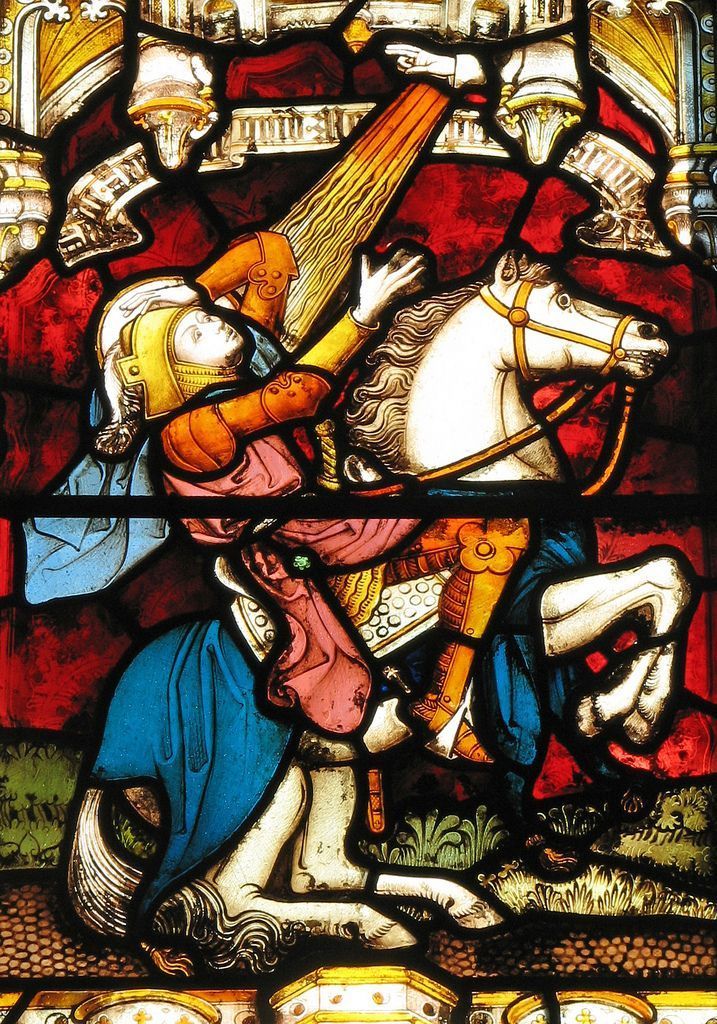
Conversion of St. Paul in St. John's College Oxford. Picture credit: Fr. Lawrence Lew OP
There is no other contemporary Christian we know as well as Shaul of Tarsus, better known as St. Paul the Apostle—and we know him so well because the Church has treasured his personal correspondence from the day it was sent to the earliest communities around the Mediterranean basin. So inspiring, so heartfelt are these letter that they were copied, and distributed to others to whom they were not addressed, that they might sit at the feet of the teacher, and learn how to be a follower of Jesus.
Of the thirteen documents attributed to Paul, no less than seven are undisputedly authentic - that is to say there is academic consensus that Paul, personally, composed them and sent them to churches and people he really knew. Of the others, not being ‘authentic’ does not cast a shadow on them. It means they were either written in his voice, or compiled of fragments and sayings from other letters. They all have a Pauline spirit, and together form what we call the Pauline corpus - the body of teachings that has its origin in this remarkable man.
That’s all very interesting, if you like that kind of thing, but why does it matter? Well, consider how much we reveal of ourselves in our personal communications. There is an intimacy in correspondence (particularly at that time) that is not found in other kinds of writing. Compare how much more we know of the character of Marcus Tullius Cicero from his letters, to the Jewish historian, Flavius Josephus. They are unedited, emotional and raw. And because of this, they give us hope. Paul is no plaster saint. He’s right there in front of us, and unlike many others he’s not afraid to lay bare his weaknesses, because of his utter confidence in Christ. He is the primordial oversharer - and this is good for us, because it gives us hope that ordinary men and women like us can aspire to follow Christ, and being attentive to his teachings, Paul shows us the way.
But Paul has come under attack, particularly in the last 50 years or so. He is attacked because his teaching is sometimes hard: he is uncompromising, and because of the power of his intellect, he is extremely clear, and persuasive. No misty arguments here. We know exactly what he means, and exactly what he expects of us. So let me be clear too - everything Paul says is correct. Everything. But to focus only on the diamond-edged precision of his teaching is to forget how remarkably compassionate and self-effacing he is too. This is an easy trap to fall into. When someone says something that is razor sharp, and clear, but we don’t like it, our first reaction is emotional - we don’t like the message, and we don’t like the messenger - and nothing else he ever says or does will lift the cloud of feeling.
But Paul is uncompromising in his teaching because he is only too aware of human weakness - and very understanding of anyone who falls short of his ideals, because he admits himself he falls short of them all the time. You must then take the whole Paul, not just bits of him.
When Paul first started writing (well, actually he rarely wrote himself - he had a scribe - and we know this because there are several points where he tells the recipient he has taken the pen himself and is writing in his own hand) but when he first started, it was by no means clear that we would have a New Testament at all. Remember, 1 Thessalonians is the very earliest Christian document - written possibly as early as AD 49 - sixteen years after the Passion and Resurrection of the Lord.
This means there were at least sixteen years of a Gospel that was not written down - “woe to me if I do not preach the Gospel” he says in 1 Corinthians about 5 years later than 1 Thessalonians. What is he talking about? Certainly not Matthew, Mark, Luke, and John. They were at least another twenty years into the future. So it is to Paul we turn for the earliest evidence of what the Church was like - and we find it to have been even at that stage both traditional and liturgical. Traditional, because the Gospel is handed down by word of mouth, and liturgical, because e.g. in 1 Corinthians we find the first, ever recorded instance of Christians celebrating the Eucharist.
Let that sink in. Paul is the first to write about the Mass - and the Mass was happening before any New Testament Scripture had been written. Liturgical, too, because Paul quotes hymns in his writings - you could say he bursts into song at points - and these hymns were expected to have been shared, and performed, with the churches he was writing to. Liturgical even more because it is Paul who writes to the churches and recalls the power of their Baptism - he assumes they already know what Baptism is, because they have received it. And no-one has ever been baptized outside of the Liturgy. Scott Hahn, the famous scripture scholar says “[T]he New Testament was a Sacrament before it was a document, according to the document.” We could say the New Testament was liturgical before it was scriptural, according to the Scriptures.
Because we know Paul so well, we have in him a template of how to be authentically Christian. We cannot be Christian and set aside his teaching or example - that would be to reject Christianity, because he was a witness to Christ long before you or I were. But if the whole Church has this template, we have something even more special - we have Paul himself. You see, the Lord, in his goodness, has given us to Paul for his special concern. Being dedicated to him, means this same urgent, intense, generous, passionate saint has a special concern for what we do here - because we bear his name. It’s not that we belong to him - he himself would correct that - but since we belong to Christ, Christ has given Paul to us as patron and intercessor - and you can be sure he takes his job very seriously indeed.
Bearing his name them, let me paint a picture of how a Catholic Parish should be authentically Pauline. It must be faithful, traditional, open, generous, compassionate, giving, inquisitive, and most of all, loving. But there’s one thing it can never be: casual. I don’t know if casual gets you to heaven - who am I to judge - but I do know that heaven is a kingdom, and we are not all equal there, so there is every reason while we have breath in our body to “strive for the higher gifts” as Paul says. Together, we have a chance in this life to grow in holiness, and that takes effort and openness to change; it takes humility, and a readiness to be taught. But let’s leave the last word to our heavenly intercessor:
“Do you not know that in a race all the runners run, but only one receives the prize? So run that you may obtain it.”
Recent Posts