Water and Blood
Rev. Michael J.V. Clark • January 12, 2026
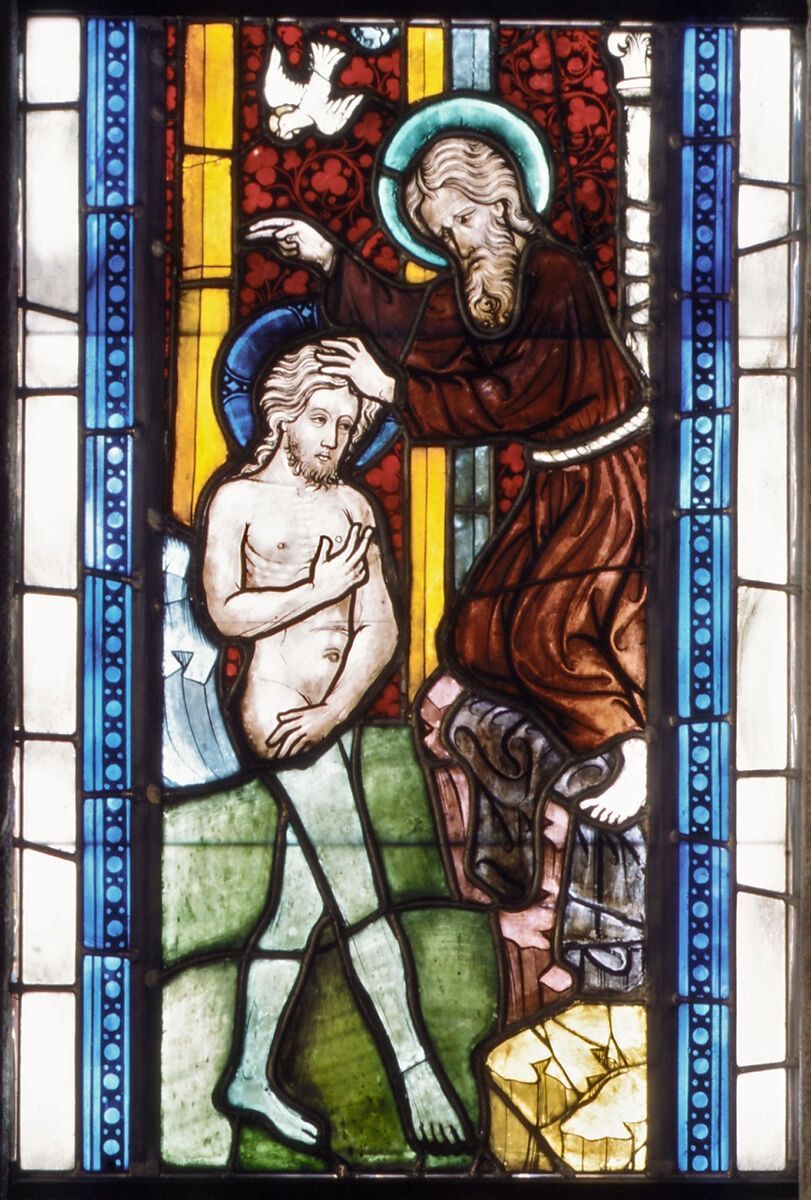
Have you noticed we have moved at liturgical lightning speed in just a week? Faster, in fact! Last Sunday, we were at the manger with the Magi, this week we come to the Jordan River, where the Lord is all grown up. Or rather, as Luke tells us, he “advanced in wisdom, and maturity, and favor before God and man” (Lk 1:52.) And he comes to be baptized by John the Baptist.
Wait, a moment. He comes to be baptized? He advanced in wisdom? And favor with God? I thought you said this was the Word made Flesh, God with us? Why does he need to be baptized? How can he advance in wisdom if he is the source of wisdom itself? How can he grow in favor with God, if he is God? These are all excellent objections - and they are precisely what we see in John’s reluctance to baptize the Lord:
John tried to prevent him, saying,
“I need to be baptized by you,
and yet you are coming to me?”
The Baptism of Jesus is more than merely a historical record. The fact the Lord chooses to perform this sign means he wants us to know something. Now, we could just pass it over, shrug our collective shoulders and say ‘I dunno’…or we can delve into the mystery, and discover the sparkling beauty of God’s plan for us.
First, let’s recall the background. Remember, in Advent, we agreed that John’s Baptism was the precursor to the Sacrament of Penance (also known as Confession) rather than the precursor to the Sacrament of Baptism. We also concluded that John’s Baptism was an interior recollection - a desire for a fresh start with God - journeying in to the desert, a ritual dying to sin, and being reborn.But it always pointed forward to something greater. As the Baptist himself said:
I baptize you with water for repentance, but he who is coming after me is mightier than I, whose sandals I am not worthy to carry. He will baptize you with the Holy Spirit and fire. (Mt 3:11)
Now, Jesus, who is perfect and sinless by nature, has taken upon himself our humanity. God has clothed himself with flesh and now dwells among us. His humanity is not wounded by sin, but ours is, and Jesus is the only way that mankind can be reconciled to God, because only his sinless sacrifice could ever be acceptable to the Father.
So in submitting to John’s Baptism Jesus is really putting a definitive end to it, inaugurating a new Baptism into his body - the Baptism that you and I enjoy - that will be practiced by his coworkers, the Apostles, because of the commission Jesus will give to them to baptize all nations in the name of the Father, Son and Holy Spirit. He enters the waters to fulfill all righteousness: to stand in solidarity with us, even though we don’t deserve it, and to bring John’s preparatory baptism to its fulfillment. In that very moment, the old yields to the new.
Secondly, let’s consider the deeper typology. Baptism is a symbolic death - the Hebrew people were culturally fearful of water - they were a pastoral people, not a seafaring people: the sea, and its chaos was something to keep at arm’s length. As an aside we see remnants of this in the early Church - the book of Revelation describes the new heaven and new earth as a place without a sea: something which my naval officer father will definitely have to learn how to appreciate.
If the sea is dangerous, and the waves are frightening, then going underwater is a metaphor for death - and rightly so. By submitting to John’s Baptism, Christ is not signifying his need for repentance at all, but he is pointing to a different sign - that he will have to die in order to save his people from their sins.
It was John, after all, that recognized that Christ is the Lamb of God. Almost nonchalantly, he points to the Lord from afar with words we recall at every Mass: ecce Agnus Dei! Behold the Lamb of God! John’s disciples knew what that implied. The Lamb is always the sign of sacrifice, from Abraham and Isaac to the blood smeared on the Passover doorposts - the spotless Lamb is born to be slain, and therefore the symbolism of the Lamb descending into the waters was even clearer to those who witnessed it than (perhaps) it is for us.
But thirdly, what about advancing in wisdom, and stature, and favor with God? How do we begin to deal with that? Well, we confess that Christ is true God and true man. Not a hologram, or a chimaera. As true man, he chose to experience a defining characteristic for all of us: growing up. It stands to reason that a baby is innocent, but a baby needs to grow…Christ in the manger is all-beautiful, but he cannot preach or teach (at least not with words.) It is his sinless humanity that may advance in wisdom, and stature, and even grace. But remember this - he is at the same time the one who receives this growth, and the one who gives it. The source of his wisdom, and stature, and favor, is the divine life itself, which he shares in the communion of the Holy Trinity before all worlds.
St. Cyril of Alexandria helps make sense of this interplay: “God the Word gradually manifested His wisdom proportionably to the age which the body had attained.” The divine wisdom was not lacking; rather, in the economy of the Incarnation, it was revealed step by step, according to the Lord’s human nature’s capacity to receive it—so that we might recognize Him as truly one of us.
The Baptism of Christ is that point of recognition. We see him clearly now. For thirty years, in the hidden life of Nazareth with Mary and Joseph, the Lord’s humanity has grown in stature both body and soul. At this point of his life on earth, he is ready to reveal to the world his anointing with the Holy Spirit, and his favor with God the Father. This is why the Baptism is also a form of epiphany - a manifestation of something we need to know and understand about Jesus.
But the revelation of his anointing is not simply for us to marvel at the Godhead. At two points in the Gospel of John, Jesus reveals himself as a wellspring of living water; a source which when we partake of it, becomes a spring in us for others to draw upon. This divine life was imparted to be shared - the living water is the action of grace by the Holy Spirit, that is applied to us because the Lamb of God renders a perfect sacrifice to the Father. He is the one to hand over that life! Just as he hands it over to the Father at Calvary, he hands it over to us in the Sacraments.
You see, the water alone is not sufficient, we need the water and the blood. Indeed the water only makes sense because of the blood. If you drink deeply from this fountain there will be a moment of manifestation, of showing forth, for you - your hidden life will bubble up, and bubble over with living water. Your own trials, frustrations, and sufferings are precisely the Jordan River for you. Imitate Christ in prayer and holiness and you will rise with him from those waters of strife, and advance in wisdom, maturity and favor with God and men.
Recent Posts