Crib and Cross
Rev. Michael J.V. Clark • January 6, 2026
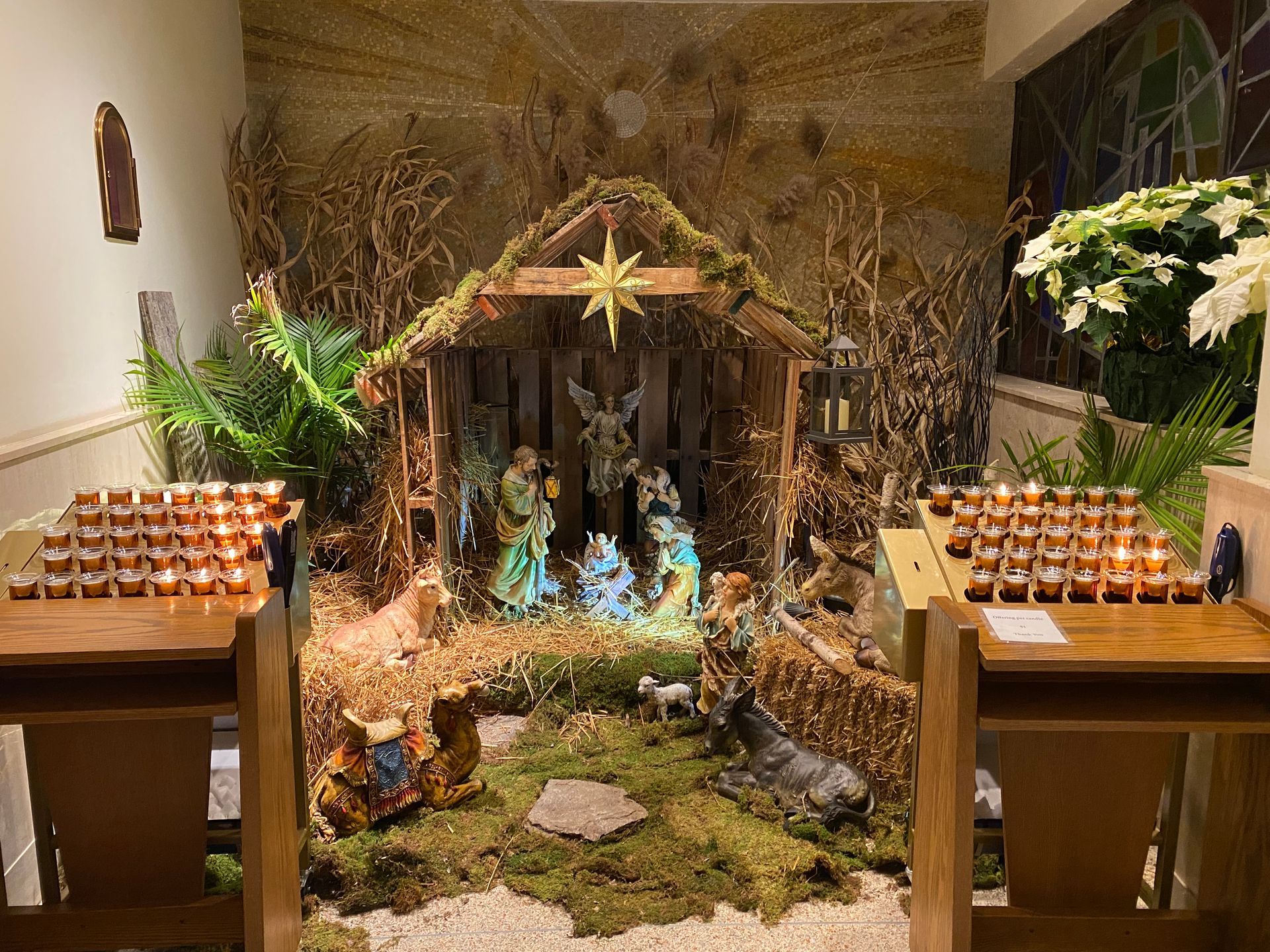
I’m a risk taker by nature. It’s in my personality. If I see a third rail, I’ll jump on it. Looking out at the congregation in Greenwich, CT I daresay I’m in good company. Now, if you’re not so familiar with the inner workings of a Catholic parish, the Christmas Pageant is probably “third rail ++” here at St. Paul’s, sitting as it does at the intersection of 'Christmas traditions' with 'Glenville moms.'
So I rewrote the Pageant. All of it, and my aim in doing so was to be faithful to the Bible story, and in particular the dialogue. I wanted Gabriel to say the actual words to Mary, and for her to respond: I am the handmaid of the Lord. So the Little Drummer Boy had to go. Out he went - of all the stretches I might have tolerated - no. Not him. He didn’t make the cut.
“Father, we need to talk about the Pageant…”
The call came later that night. Oh dear. Come back, Little Drummer Boy! All is forgiven…
Thank God they didn’t know I was this close to removing the Innkeeper - and the Inn. That’s right. Here’s the first time 'Father Grinch' can steal your Christmas by telling you - there was almost certainly no Inn, and Our Lady and St. Joseph were not wandering refugees looking for board and lodging (at least not that night, in that place.)
“And she brought forth her firstborn son and wrapped him in swaddling clothes, and laid him in a manger, because there was no room for them in the inn.”
So familiar isn't it? As familiar as pageants, tinsel, angels, and presents. The whole heavy lift of our wonderful Christmas traditions. But if we leave Christianity behind in our childhood, with the candy canes and the fairy lights, we will never discover a religion far deeper, and more sophisticated, than we might ever know. If there’s only one thing you remember from my sermon this year it is this: look again at the Faith you think you know.
Come with me a moment - and let’s revisit the Inn. The word Luke uses in 2:7 is fascinating, and deliberate. Not no room for them in the inn, but instead, no place for them in the katalýma.
Luke uses this word, katalýma, only twice in his Gospel; (when you see a word only once in the Bible, it’s a red flashing light; when you see a word used only twice, it’s a five-alarm fire,) Katalýma you see does not chiefly mean 'inn' - it means guest room, or lodging place. Somewhere set apart for visitors. It’s not actually the word Luke uses for ‘inn’ - remember, the parable of the Good Samaritan? It is only found in Luke - and there he uses the word, ‘pandochíon’ for a wayside establishment for itinerant travelers.
Luke uses a different word to describe: (a.) the guestroom in Bethlehem, where there was no space or privacy to give birth to a child, and, (.b) the upper room in Jerusalem, where this child, once laid in a feeding trough, would go on to feed his followers with his own flesh, by his own hand. Katalýma, then, is best translated as ‘upper room’ and not ‘inn' - it is related to the Greek verb for loosening, or throwing down, and you can imagine the first thing your visitors do when you receive them into your home is to throw down their belongings.
This all makes so much more sense when you consider the wider historical context. Remember, our religion is a Middle Eastern one, and we may have some work to do to reconstruct Middle Eastern social customs that are implicit in the sacred texts. Joseph and Mary have traveled to Bethlehem, because it is Joseph’s hometown; he is from Bethlehem. It is thus inconceivable that a family member would travel to their hometown and not stay in the family home, particularly when we know that Joseph is of the house and line of David, and is coming home to David’s city.
We don’t know the reasons why the upper room had no place for them. Perhaps the house was full to bursting? Or perhaps the Blessed Virgin retreated to the only space left she could give birth in peace and privacy, but what we do know is that the Lord did not enter into the upper room that night. Not yet. But one day he would.
This is the strangeness of our faith. Christianity isn't a tidy story of a heartless innkeeper or a sentimental stable scene. It's wilder, and more paradoxical: the infinite God contained in a tiny body: the vulnerable one who is invincible, the victim who is a victor, accessible, yet still unapproachable.
You see, what Christmas begins - the upper room completes. There, finally, this child will take bread and wine and say, "This is my body, given for you." That upper room is truly a place of loosening, or throwing down, because it is here the saving act of Calvary is given as gift to us. Through the Eucharist, Death flees away and life enters in. This is the great exchange - we bring not gold or frankincense, but our broken hearts, our burdens and we lay them at the Altar of the manger, upon the sinless body of this innocent babe. And he in return, will break this tiny body for us on the Cross, and share all he has with us, even though we do not deserve it. So if you cannot love him for his Cross, you must love him for his Crib, for they are one and the same. What Christmas begins - the upper room completes.
Recent Posts