
What's it to You?
Rev. Michael J.V. Clark • January 20, 2026
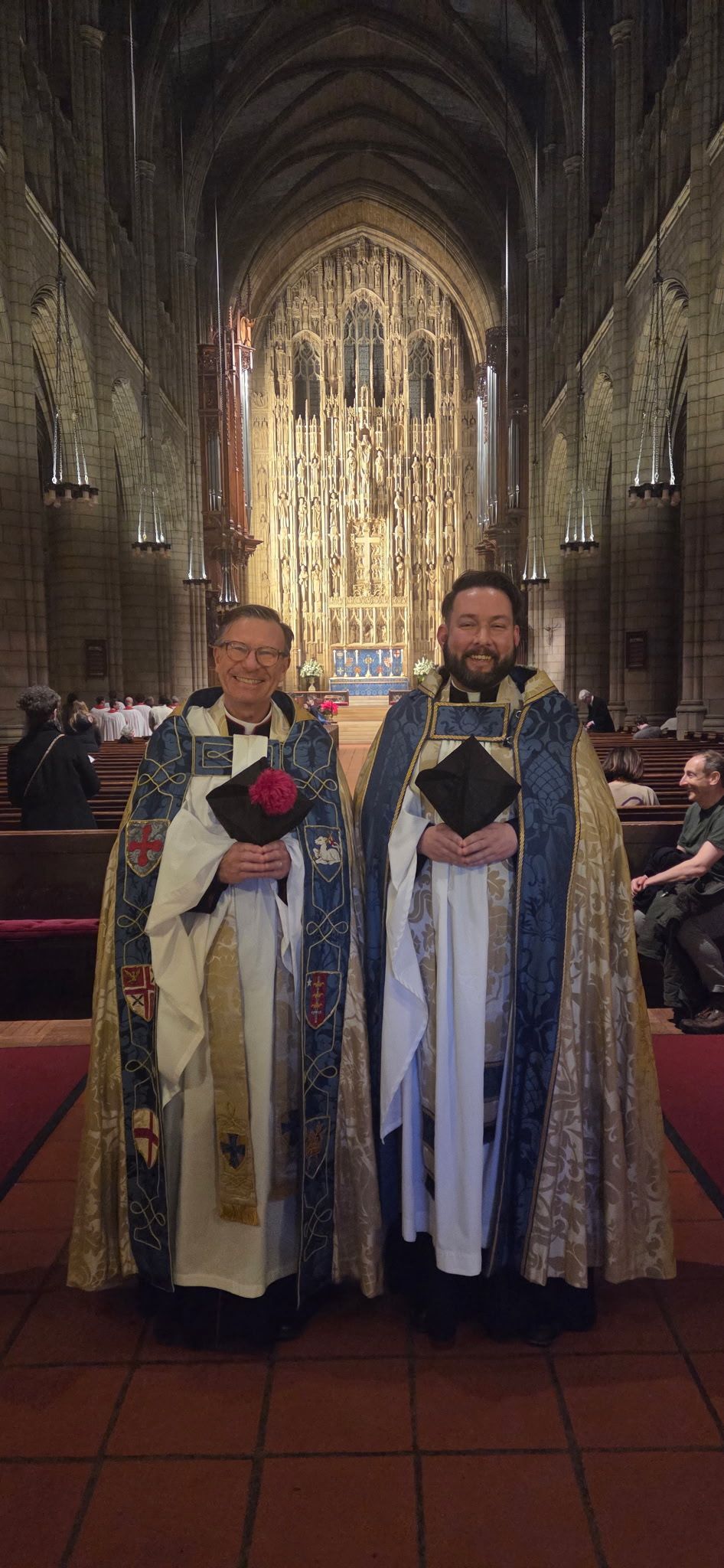
Fr. Clark gave this sermon at Evensong on January 18th for the beginning of the Week of Prayer for Christian Unity at St. Thomas Church, Fifth Avenue, New York City as guest of the Rector, the Rev. Canon Carl Turner. Fr. Clark and Canon Turner are pictured above.
I’m waiting for a call from Rome. I’m sure it’s coming any day now, and the Pope will say to me: ‘Fr. Clark, you’re doing such a great job, I’m going to appoint you as Prefect of the Dicastery for Promoting Christian Unity.
I think my first act will be to choose a new motto. I’m not even sure if the DCPU has one already, but it should. But since a motto is part of heraldry - you guessed it - there are lots of rules, so we need to proceed with caution. [I’m sure my brothers and sisters of the clergy could offer some helpful suggestions, but I probably can’t repeat them here.] Best to stick to Scripture. Fortunately our Second Lesson tonight provides the perfect text for the motto, from the Lord’s own lips: tí pròs sé.
What’s it to you?
But let us understand one thing very clearly about these three little words: it is a rebuke - and it was issued to Peter just moments after the Lord gave him pastoral charge over the flock. The same Peter, whose confession of Faith at Caesarea Philippi remains a point of unity for all Christians, is rebuked at the very moment his eyes are not fixed upon his relationship with Christ, but upon someone else’s relationship with Christ.
It’s important to observe two things about this passage: first, we only know about it because Peter was content for it to be shared - indeed, the author of record is the ‘someone else’ Peter was enquiring about, namely John the Beloved Disciple, who is clearly anxious to correct the rumor that the Lord said he would never die. Even though it isn’t a flattering portrayal of Peter, it’s an important one, because it teaches us the futility of comparing our relationship with Christ to another’s.
We must also take heed of the fact that Peter’s temptation occurs after he has turned around. The text is very clear: epistraphèis ho Pétros - Peter, having turned around, or ‘turning about’ as we heard proclaimed, sees John, and switches his attention from the Lord and onto the disciple the Lord loves. So we are particularly susceptible to this temptation to comparison after we have turned to Christ: and therein we see the first seeds of disunity that the Evil One wishes to sow amongst the brethren. Instead of a vertical relationship with the Lord, Peter looks to the horizontal - what about him, Lord?
In this Week of Prayer for Christian Unity, it is worth pausing to reflect on how far we have come on this journey together - polemic between Christians tends to be reserved these days for social media (God forgive us) and not official channels but there is still much more to do, so let me offer tonight three areas for further reflection:
The first is, to insist upon the vertical dimension with Christ and not the horizontal. Fix our eyes upon him and him alone, so when we quibble to the Lord about our brothers and sisters (whether within or without our own church communions,) let us hear him say: tí pròs sé - what’s it to you?
So what if their pathway is different from yours?
Instead, follow me.
The second is, to recognize that things that are important to us are emotional, but emotion is not always the best barometer of progress. A good example of this concerns Holy Communion. Whenever I attend the Divine Liturgy in an Eastern Orthodox church, I am not invited to concelebrate, nor to receive Holy Communion. There’s a sadness in that, and it’s certainly emotional; but if I dwell on the externals, I fail to see the high degree of communion I already share with my Orthodox brethren. So when we feel despondent: again, let us hear him say: tí pròs sé - what’s it to you?
Are you not able to offer me a sacrifice of praise all the same? Are you not able to present your body a holy, living sacrifice? Of course you are.
Instead, follow me.
Thirdly, and finally, to move from respect for one another’s traditions to reverence for them. God desires legitimate diversity: he does not insist that we all worship him in identical ways. Our unity is not expressed with a liturgical cookie cutter, nor a theological one - and it is through our differences that God can show himself to us to in the other. We need only look to the noble tradition of choral excellence, for which this church is justly famous, as an example of the gold that God is able to create, even out of canonical division. So, if someone prays or expresses themselves in a different way to us: again, let us hear him say: tí pròs sé - what’s it to you?
Do they not come even from Sheba and Seba bearing gifts? They absolutely do.
Instead, follow me.
Recent Posts