Mind the Gap
Rev. Michael J.V. Clark • December 1, 2025
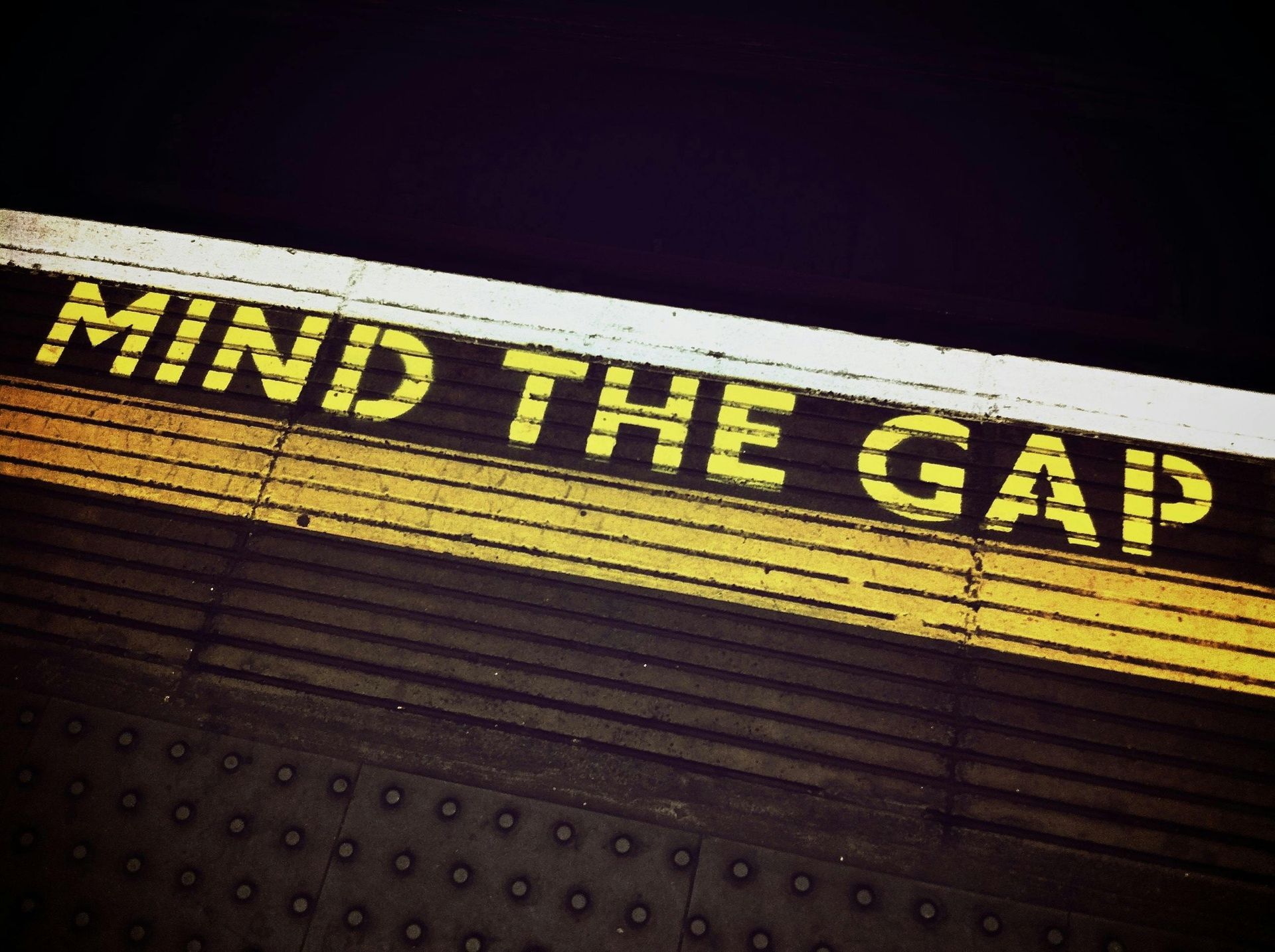
Like any great city, London has its idiosyncrasies, and the Underground is symbolic of the hectic busyness of the British capital. Thousands upon thousands crammed into its tiny tubes around corners so tight as barely to keep the cars on the rails. This means the stations are often built on curves with precipitous chasms between the cars and the platform edge: “Mind the Gap” the disembodied voice booms at you.
I remember it every year at this time, (and not just because I love trains): it’s an excellent message for Advent.
For Advent reminds us that you and I live in a very particular ‘gap’ - namely, between the First Coming of Christ, and the Second. The gap is the age of the Church, where we recognize that Christ, yesterday and tomorrow, the Alpha and Omega has come, and will come again.
Pope Benedict XVI frequently used the delightful Italian aphorism:
già, ma non ancora in his preaching on Advent. A phrase that means ‘already, but not yet' in English. It's Advent in a nutshell. As the Pope reminded us:
The ‘already’ of the Kingdom that is present in the person of Jesus is a gift offered to us, but it is also a responsibility: the responsibility of cooperating with the work of God, of bearing witness to his Kingdom in the world. And this is the ‘not yet’—the journey, the pilgrimage of the Church through history, until the full manifestation of the Kingdom.
We live in this tension, as if the cinematic reel were stuck between the frames. We know that Christ has come, but he seems delayed in his return. This leaves us with a profound spiritual instability that comes in the form of two temptations: the first, to assume we know everything about the Word that God has spoken, and the second, to imagine that God still owes us a different Word, a fuller explanation than he has already given.
The balm for both temptations is to accept Mystery - to accept the otherness of God, and to have peace in not knowing all the answers, and in so doing we realize the spiritual instability is deliberate on God's part. But let’s deal with those temptations to unrest one by one, starting with the second:
You may remember the postwar academic dream of a ‘Theory of Everything' - one final equation from which the code of the whole universe could be mathematically derived. The late Professor Stephen Hawking once believed we were on the cusp of finding it, and that to find it would be to “know the mind of God” - and surpass it.
Hawking was wrong. And by the turn of the Millennium he had the humility to admit it. As a student I remember watching him going about the city of Cambridge in those very days. I often wondered whether he was disappointed that his great hope had been dashed. He gave no evidence of it. But you see, it's undeniably true that Science has had to give up this grandiose claim, because (in layman's terms) the physics of the very small (Quantum Mechanics) and the physics of the very big (General Relativity) turned out to be fundamentally incompatible. You can follow one, or the other, but if you try and marry them together - you get nonsense. As scientific journalist, John Horgan, concluded:
The universe is deeper and stranger than our minds—made, as the mystics say, in via negativa—can fully grasp.
I don’t think we have yet come to terms with the consequences of this. Many people put their Faith in the progress of Science - many good people, ordinary people. It was almost an assumption that Religion would necessarily have to cede the high ground of Truth to the triumph of human reason. Not for nothing it entered our everyday speech - think for example of the rather impolite phrase: "it's not rocket science" - as if rocket science were unquestionably the pinnacle of human endeavor. However, the more we searched the mathematics for a new Word, the stranger it became.
Ultimately, the Universe will keep its secrets, even from the greatest of minds, even from AI. The self-confidence of the giants of physics of the late Twentieth Century has now all but evaporated - but when we turn back to Religion for answers, we encounter the first temptation I mentioned, the temptation that since we already know everything there is to know about God’s Word, Religion has nothing to say.
Responding to this incredible Post-War scientific optimism, Christian denominations have long been playing catch-up. Rather than proposing the Gospel as something radically new in every generation, we have been tempted to downplay Christ’s counter-cultural demands, and make both Christian worship, and Christian theology, accessible, and comprehensible. And ‘nice.’
But whilst there is a lot that’s good about accessibility and understanding - there is a grave danger of destroying Mystery in the process. Institutionally the Church has not caught up with the reality that Science is no longer proposing a Theory of Everything. Granted there have been no white flags raised from the laboratories, but a distinct lack of confidence in academia is noteworthy. Without most of us noticing, Science is, perhaps, on the cusp of returning to Mystery. It's time for us to regain our self-confidence in an age desperately seeking answers.
You see, Mystery is not deceit, nor is it fairy tale. It is Truth shrouded in Wonder. Whilst we can never fully know the mind of God, we can know that He loves us, because He spoke the Word to us - and there is no further Word coming:
Long ago God spoke to our ancestors in many and various ways by the prophets, but in these last days he has spoken to us by a Son.
Heb 1:1-2
St. John Henry Newman is the prophet of Mystery. Having come to Faith in the crucible of Oxford, that great seat of reason, he recognized the inherent power that comes from believing in the name of the Son of God:
“The most perfect Christian is he who has learned to live upon mysteries, to rejoice in mysteries, to look forward to mysteries.”
So this is why we have Advent; with the Sanctuary stripped back, we carve out a space in our busy schedules to pause and reflect. To learn, and re-learn how to enter into Mystery. To put down the weapons of pride, and instead come to the manger-bed of Bethlehem, where the Lord who made the stars will soon lie gazing in wonder at them. Advent urges us not to fill that gap, but instead teaches us how to live in it. This gap is not a wound, nor a mistake, nor a void; it’s a pilgrimage into Truth.
Recent Posts