Out of Time
Rev. Michael J.V. Clark • November 2, 2026
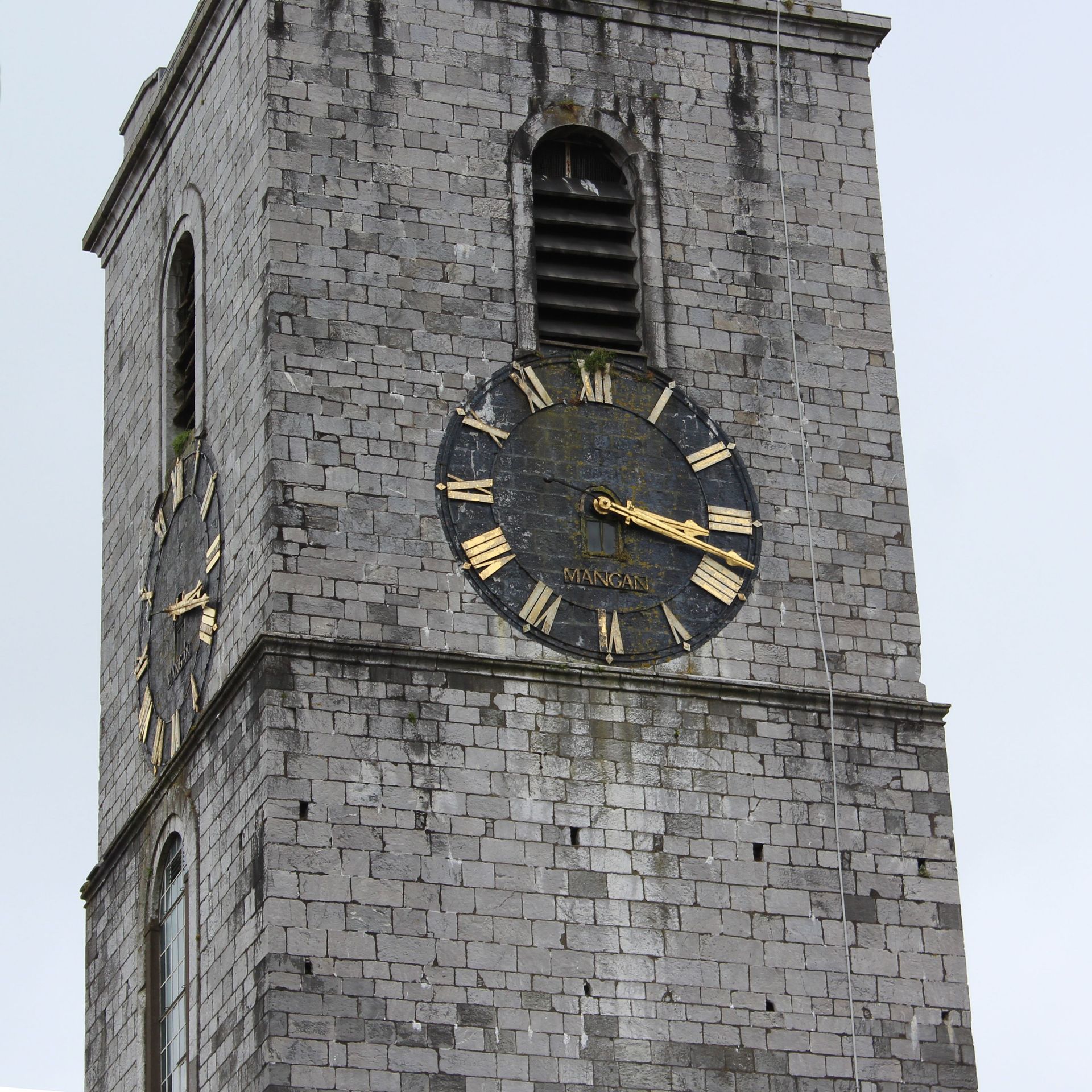
A phrase, we use quite often, intrigued me this week. The phrase is, “I ran out of time.” Considered how strange it is. I ran out of time. It would be perfectly easy to say that time ran out, but we don't say that. We make it subjective, our personal experience: I ran out of time. Doesn't that say something about the human condition? We're always looking to the next thing. A task has to be completed in a certain span of time. We're always chasing it, and we feel that there's never quite enough of it. We seem to measure everything by time: the hours, the days, the years of our lives.
But one day, quite literally, we shall run out of time. Or rather, we might say, we shall run outside of time.
The now-Blessed Archbishop, Fulton Sheen, made a cogent observation about happiness, and in particular about heaven. He urges us to consider the happiest moments of our lives.
Just think about what that might be for you. What was the happiest moment of your life? Perhaps, to cite Blessed Fulton’s examples, it was your First Holy Communion, or maybe your wedding day, or the birth of your first child? Maybe something simpler? What about an evening with friends in the high summer that seemed to go on forever?
One thing that brings all these experiences together is the sense that time stood still, or even that we were somehow outside of time.
Well, what I want to propose to you this morning is that it's no accident that our moments of greatest happiness feel timeless. The reason for this is that we, as human beings, are made for eternity.
When we forget the clock; when we wish the moment would never end, it's like a snapshot of what God, in fact, desires for us. It’s a glimpse of heaven.
I think we all have to revisit our idea of heaven. For many of us, it's something we might say we're aiming for, but we don't give it all that much thought. And when we do, the images of heaven we come up with can be rather unhelpful. They’re imprinted from childhood, but they tend to the sentimental: all pastel colors and blissful clouds. Such images can seem naive, at best; boring, at worst. I don’t know about you, but I have no interest in endlessly floating about on clouds.
But heaven isn't simply endless time. It's not more, and more, and more, of the same. It's not merely an extension of this life, either.
Sometimes when I remind you that heaven is the liturgy, those of you who get anxious when we get to the fifty-five-minute mark of Holy Mass might be quite perplexed at the idea of heaven being the liturgy without end! But it's not that. Heaven is the liturgy without time, not simply without end.
Heaven is our participation in the eternal happiness of God. No one is happier than God Himself, and God invites us into that happiness.
Heaven is seeing God face to face, to know Him and to be known by Him without anything standing between us. It is the fulfilment of everything for which we were created and that perfect communion with God is itself the eternal worship of the Father.
This is the possibility which Christ has opened up for us through the Paschal Mystery. Those who enjoy that happiness are commonly called saints. Heaven does not have a two-tier system. It's not the case that in heaven there are the saints, and then there are the ordinary folk like you and me. No. There is no one who is in heaven who is not a saint.
Let that sink in for a moment.
There is no one in heaven who is not a saint.
Therefore, if you and I wish to be in heaven, we too must be saints.
And given that, we can see that holiness (‘sanctity’, ‘being a saint’) is not an optional extra for the particularly devout. It is the destiny of every Christian soul.
Moreover, it is not achieved by our own efforts. We do not make ourselves saints. God makes saints of us, by the transforming power of his grace. Our task is to receive that grace and cooperate with it.
But since a saint is what you and I are meant to become; this reception and cooperation with grace is how human beings are designed to be, and our lived experience of moments of greatest happiness, those timeless moments, gives us a clue as to what human destiny really is.
When I was talking with the children at the 9:30 Mass, I asked them if they played trading cards. They do, but you already knew that. When I was younger, in England, we had a trading card game called Top Trumps. There were different categories of cards, perhaps motorcycles or trains, and all the data was printed on them. It was great for boys! You knew how much horsepower your motorbike had, or how powerful a particular railway locomotive was, and you played the game by comparing those figures.
I think the Feast of All Saints can feel a little bit like Catholic trading cards, can’t it? All Saints: all our favorite saints gathered together. All the familiar names, all the great figures of Christian history.
But it's not merely an omnium gatherum. It’s not simply a celebration of all the saints we know about, and that's it. It's not a ‘collect the set’ situation. The Feast of All Saints celebrates all the saints, including the countless multitude whom we don't know, whose names are known only in heaven.
Can you imagine a trading card game where the cards had no names or pictures, because the people represented were known only to God? It wouldn't really work, would it?
But that is what this feast reveals to us: that great multitude which no one could number, from every nation, tribe, people and language, standing before the throne of God, as St John describes in the Book of Revelation. They have reached their destination.
Now, let's fast forward to November 1st, a hundred years from now. Maybe a few hundred years. My successor, I hope, will still be in this place, offering worship to Almighty God on this Feast of All Saints.
I suspect almost all of us in here will be dead in a hundred years' time. I can’t say all of us, because there are some infants who may not be. You know what medical science is like!
But nevertheless, on that day, when my successor celebrates the Mass of All Saints, perhaps, perhaps…he might be celebrating one or two, or more, of you. Even me!
And the reason I say that is because All Saints could really be the feast of you and me. This is what God wants for every single one of us. The saints whose glory we celebrate today had lives like yours and mine once. They walked this earth. They had their joys and sorrows, their hopes and disappointments. They struggled, they fell, they repented, and by the grace of God they persevered. And now they see the face of God in all eternity.
That is what this feast is celebrating. It’s achingly hopeful!
Perhaps when that future priest celebrates the Mass of All Saints here, he will be celebrating your perseverance, your sanctification, your arrival home. He may not know your name. He will not know the struggles you endured, the sacrifices you made, the occasions on which you fell and, by God's grace, picked yourself up again.
But God would know, and the host of heaven would know. And you would be among that countless multitude, rejoicing in his presence.
To conclude, let us remember that we have only a limited span of years on this earth. What we do today matters eternally: every act of love, every act of repentance, every response to grace, we are being prepared for the happiness for which we were created.
There is a paradox here: we have a limited amount of time to prepare for happiness without limit.
We shall all one day run out of time. But since we were made for eternity, may it please Almighty God that another day, this Feast of All Saints, will also be the feast of you.
Recent Posts