The Organs
Great
8′ Principal
8′ Chimney Flute
4′ Octave
2⅔′ Twelfth
2′ Fifteenth
1⅗′ Seventeenth
Mixture IV
8′ Trumpet
Swell (enclosed)
8′ Stopt Flute
8′ Dulciana
4′ Recorder
2′ Principal
2⅔′ Cornet III
8′ Cremona (Prepared)
Pedal
16′ Stopt Bass
8′ Principal
4′ Octave
8′ Trumpet (Great)
Mechanical key action
Equal Temperament, A=440
Main Organ
Noack Organ Co., Opus. 109
Thanks to the generosity of several benefactors, St Paul's Church is privileged to possess a pipe organ built by the distinguished Noack Organ Company. The builders' Opus 109, the instrument was originally constructed for Holy Trinity Episcopal Church in Memphis, Tennessee. Following its acquisition by St Paul's, the organ was carefully dismantled, transported to Greenwich, and reassembled in September 2026, undergoing extensive refurbishment, regulation, and tonal finishing in its new home.
Founded in 1960 by Fritz Noack, the Noack Organ Company has played a significant role in the revival of traditional organ building in the United States. Drawing inspiration from the great instruments of northern Europe, particularly those of Germany and the Netherlands, the firm has become renowned for its mechanical-action organs, distinguished by their fine craftsmanship, clarity of tone, and responsiveness to the player's touch.
Opus 109 is a two-manual instrument with an enclosed Swell division and mechanical key action. Its tonal design reflects the principles of classical organ building, combining a clear and articulate principal chorus with a varied palette of flutes and other colours. The instrument is equally suited to the accompaniment of congregational singing, the support of St Paul's professional choir, and the performance of a broad range of organ repertoire.
Chamber Organ
Bennett & Giuttari, Op. 12
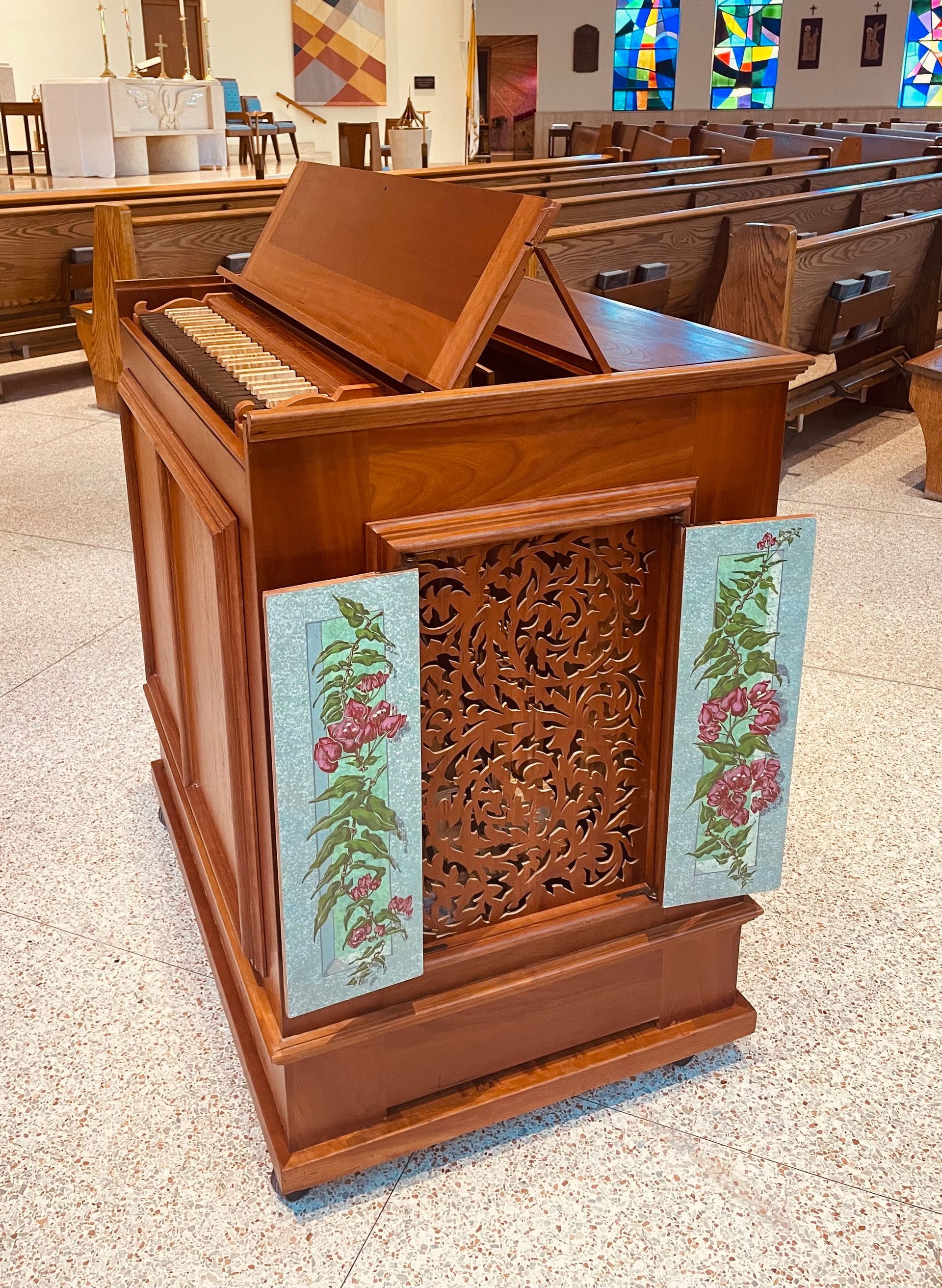
Thanks to the generosity of an anonymous donor, St Paul's Church is privileged to possess a continuo organ by Bennett & Giuttari. The builders' Opus 12, the instrument was originally constructed in 1999 for a church in Texas. It has undergone a full refurbishment and rebuild prior to its arrival in Greenwich in June 2026.
Bennett & Giuttari were among the pioneers of the American early-music movement, gaining particular renown for their historically informed reconstructions of Renaissance and Baroque keyboard instruments. This three-rank instrument is based upon the Kistenorgeln ("box organs") of seventeenth-century Germany. Such organs were frequently employed to accompany choirs and instrumental ensembles, providing a flexible and portable alternative to larger church organs. In keeping with these historic precedents, all pipework is constructed of wood and housed within an elegant cherrywood case adorned with hand-painted door panels and decorative fretwork.
Though modest in size, the organ possesses a remarkably warm and engaging tone. Its transposing keyboard permits performance at a variety of historical pitch levels, making it particularly well suited to the music of the Renaissance and Baroque periods.
Specifications
8' Gedeckt
4' Rohrflöte
2' Holzprincipal
C–d'''
Sliding keyboard A = 392, 415, 440, and 465 Hz